

Discovering the Val Camonica, the first Italian UNESCO heritage site since 1979, with over 200,000 rock engravings and ancient paths that cross millennia of history, tracing a unique itinerary between art, nature and traditions.
Known as the "Valle dei Segni" for its extraordinary rock engravings, the Val Camonica, in the heart of Lombardy, offers much more than the famous tourist resorts of Ponte di Legno and Tonale. Its medium and low parts have unexpected surprises, including thermal baths, UNESCO sites, Renaissance pictorial cycles, routes for cyclists and heroic vineyards. A trip to this valley means immersing yourself in a territory where nature, culture and history blend into a unique experience.
Index of Article
The Rupestri engravings of the Val Camonica World Heritage Site
The Val Camonica one of the greatest archaeological treasures in the world: the Rupestre Art, registered in 1979 as the first Italian site in UNESCO World Heritage List. With over 200,000 catalogued engravings, this amazing open-air gallery is one of the largest concentrations of rock art globally. Engravings tell the millenary history of the Camune people, a people who, through his art, becomes a symbol of the entire European civilization.
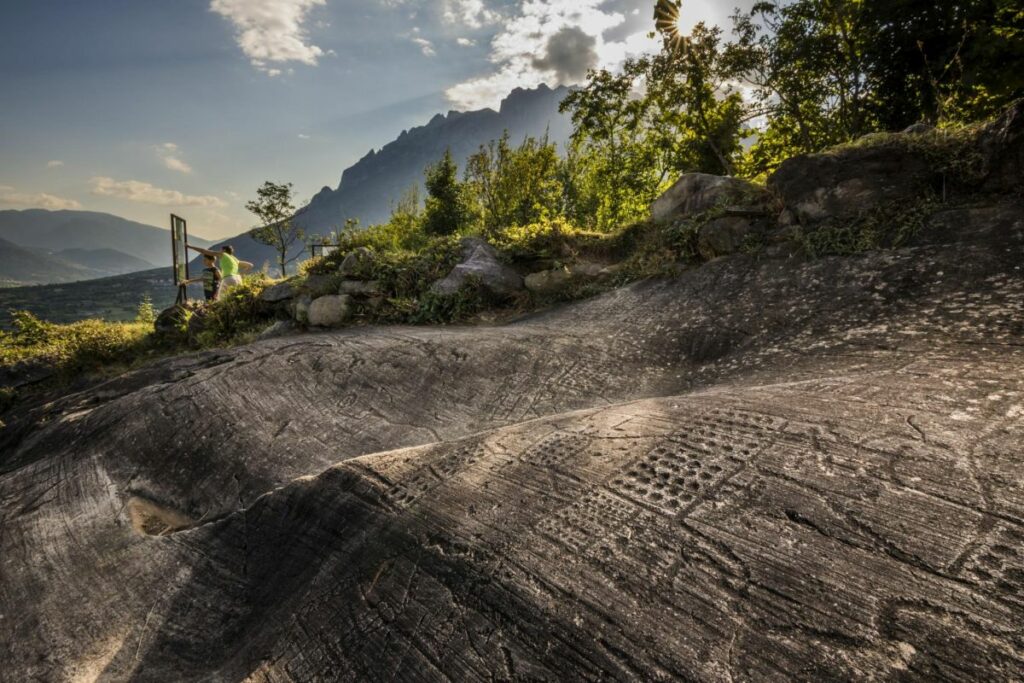
Explore these sites, spread over 180 areas in 24 municipalities, is how to undertake a fascinating journey back in time, which covers 12,000 years of history. From the end of the Upper Paleolithic (13.000-10.000 years ago) to the Iron Age, and then to the engravings of Roman, medieval and modern times, each engraved rock narrates fragments of daily life, scenes of hunting, sacred rites and enigmatic symbols such as the famous Camuna Rose, today symbol of the Lombardy.
The Camonica Valley is ideal for a family visit, with routes suitable for young and old. Losing among the engravings is not only a cultural experience, but also a walk surrounded by nature. Eight archaeological parks have been created to protect and value this extraordinary heritage, each with a poster that helps visitors to interpret the complex language engraved on mass of each shape and size.
The area of Capo di Ponte is the heart of this route. Here is the Naquane National Engraving Park, established in 1955 as the first Italian archaeological park, which houses over 30,000 figures engraved on 104 rocks, the largest grouping of rock art in the world. Within a short distance visit the Masses of Cemmo and the municipal archaeological park of Seradina and Bedolina.
Other important parks are located nearby, such as those of Lake Moro, Luine and Monticolo in Darfo Boario Terme, and the sites of Ossimo, Ceto, Cimbergo, Paspardo, Sellero and Sonico. For those who want to deepen the prehistoric history of the Camonica Valley, the National Museum of Prehistory in Capo di Ponte exhibits finds and engravings, offering a complete picture of this incredible artistic and cultural epoeia.
Roman Traces between the Alps
In addition to rock art, Val Camonica preserves important testimonies of the Roman period. The Archaeological Park of Cividate Camuno, the ancient Civitas Cammunorum, offers an extraordinary view of the remains of theatre and amphitheatre, set in a natural landscape of rare beauty. The archaeological finds, including a rare statue of Minerva in Greek marble, are preserved in National Archaeological Museum of the Camonica Valley.
Another place of great charm is the Sanctuary of Minerva, located in a suggestive area at the foot of a rocky cliff, where caves and natural tunnels add a touch of mystery to the sacred site dedicated to the goddess of wisdom and war.
Frescoes and Castles: A Route between Art and History in Val Camonica
The Val Camonica is a real outdoor art gallery, where extraordinary cycles of frescoes decorate numerous churches, creating a unique path to discover masterpieces still little known. Among the protagonists of this artistic heritage stands Giovanni Pietro da Cemmo, one of great masters of the Lombard Renaissance active in the second half of the fifteenth century. His works, characterized by a Gothic style of Lombard-Venetian inspiration, are visible in many churches of the valley.
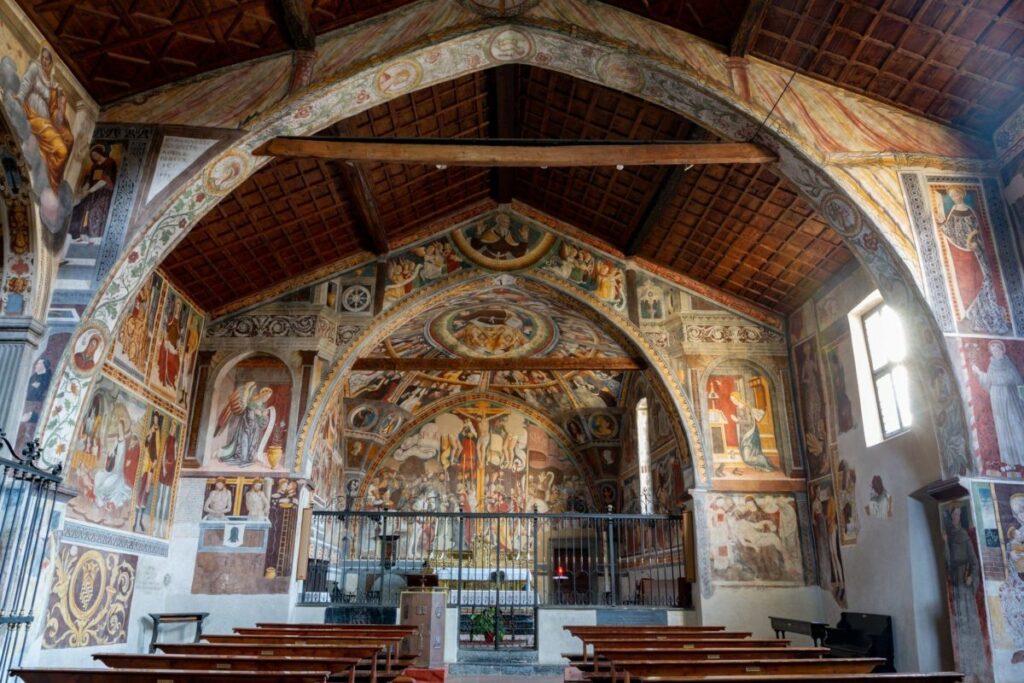
In Sanctuary of the Annuncia in Piancogno, the artist has made frescoes that tell episodes of the life of Christ and the Virgin Mary, with a still markedly Gothic imprint. However, it is in the Church of Santa Maria Assunta in Esine that is its absolute masterpiece: here, the pictorial cycles depict devotion to Saints Taumaturghi and the life of the Virgin Mary, with an exceptional stylistic refinement.
In Bienno, in the Church of Santa Maria Annunciata, the work of Giovanni Pietro da Cemmo dialogues with the works of another great artist, the Roman. The latter frescoed the presbytery with a cycle dedicated to the Annunciata Virgin, while Cemmo painted episodes of the life of St. Francis and a splendid representation of the Sibille.
The Romans also left an indelible mark in the Church of St. Anthony in Breno, where the presbytery is decorated with scenes taken from the Book of Daniel. Although only part of the original cycle is visible today, the visual impact remains remarkable.
Another must for art lovers is Pisogne, on the shores of Lake Iseo. Here is the Sanctuary of Santa Maria della Neve, often called "The Sistine Chapel of the Poor", because of the majestic cycle of frescoes made by the Romanesque between 1532 and 1534. The scenes of the Passion of Christ, depicted with an impressive theatricality, cover the walls and ceiling of the church, accompanied by images of the Prophets and the Sibille.
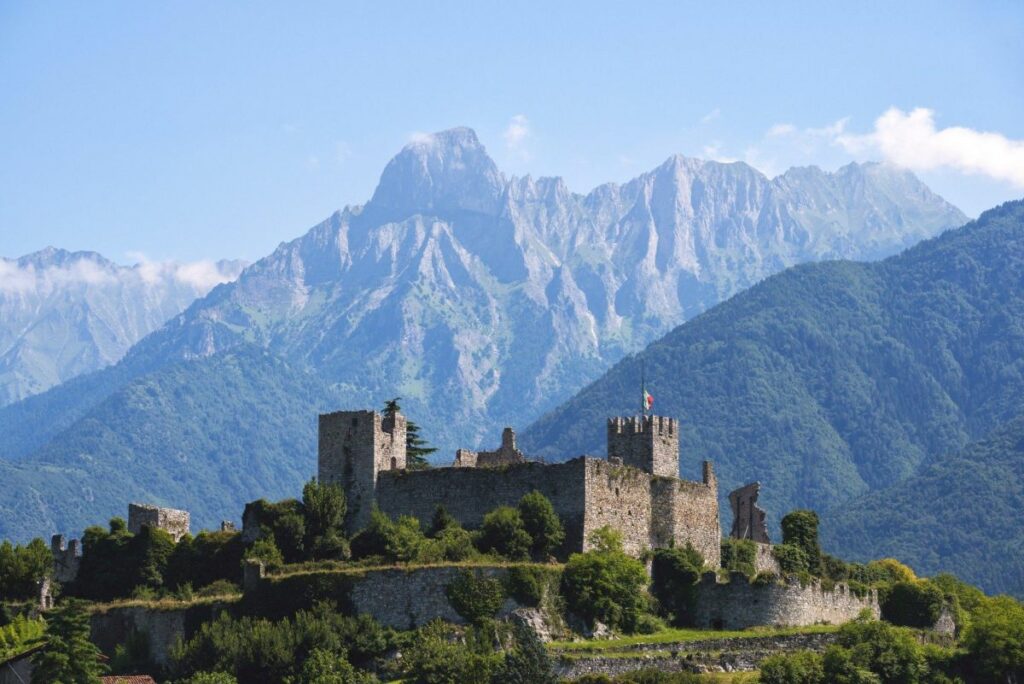
For those who want a dive in history, a visit to the Castle of Breno is a must. Located in a dominant position above the village, the castle offers spectacular views of the surrounding mountains. Built during the period of Federico Barbarossa (XII century) and transformed into a military fortress under the Republic of Venice in the fifteenth century, the castle tells a story that crosses different eras.
From its crenellated walls to the ancient towers, the visit to the castle is a real journey over time. Its large green spaces, moreover, are ideal for walks and moments of relaxation, completing an itinerary that combines art, history and nature.

