
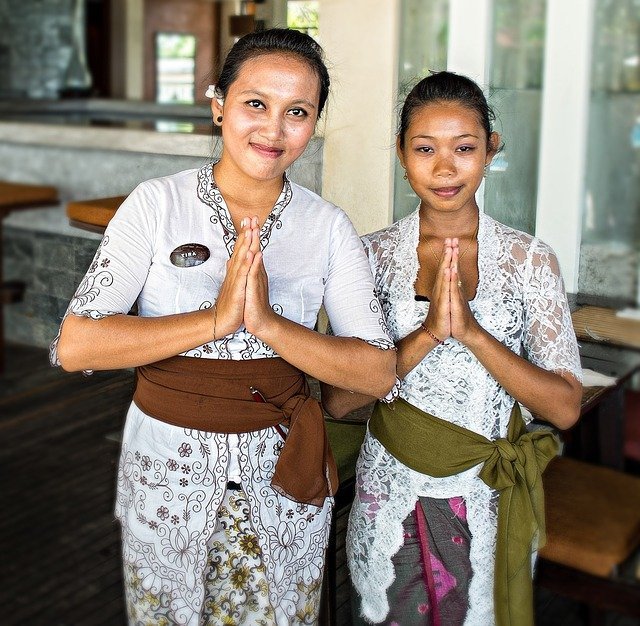
Are you leaving for an exotic destination across the world? Then you will certainly be useful to know in advance the local habits, at least regarding welcome greeting, to avoid embarrassing moments. In fact, there are those who pull out the tongue and bow, who rub their noses against that of those who are in front of them and who gives a silk scarf... Here is a roundup of the many ways to welcome them all around the world.
New Zealand
A trip to New Zealand will allow you to attend a very special and "intima" welcome ceremony. The natives, in fact, welcome visitors with Hongi, traditional greeting Maori. The Hongi, ceremonial with centenary history, consists of touch with front and nose the forehead and the nose of the person facing; it is a symbolic rite linked to has a, the breath of life, which would originate directly from God. Once this gesture has been completed, it is no longer considered manuri or guests, but tangata whenua, i.e. local people, with all the rights and duties deriving from it.
Tibet
Surely it is an uneducated gesture all over the world, but in Tibet pull out the tongue is the traditional way to welcome. Tradition dates back to the 9th century, during the reign of the wicked Tibetan king Lang Darma, who is said to have the black language. On his death, the Tibetans were so terrified that King Darma could have reincarnated, who began to say goodbye by pulling out his tongue to prove that he was not the reincarnation of the evil king. Tradition continues today and is often accompanied by hands in front of the chest.
Mongolia
During a trip to Mongolia you will have the opportunity to attend the ancient welcome ceremony still practiced in rural areas of the country. When they welcome a guest in their own home, Mongols offer a gift hada, a silk or cotton strip, generally white, blue or yellow. If you are so lucky to receive a hada, you must make a slight bow while you squeeze it between your hands; the act of giving or receiving a hada and the bow are a sign of mutual respect, a very important value in Mongolian culture. Depending on the region you choose to visit, it is also common to exchange pipes and tobacco.
Japan
The reception is very important in Japan and the bow is the traditional way to welcome guests. The traditional bow can vary from a slight nod with the head up to a bending of ninety degrees; the longer and deeper the bow is, the greater the respect that leads to the person who is in front. If welcome happens on tatami, traditional Japanese pavement, before making the bow it is necessary to kneel. Among the young Japanese are common light mentions with the head instead of the traditional inchini, for a more informal and casual welcome.
Kenya
Who makes a trip to Kenya can't help but get in touch with the Masai, the most known tribe in the country. The most fortunate can then witness one of the most fascinating traditions, the welcome dance of the Masai; dance is called Adamu, jump dance, and is performed by the warriors of the tribe. Traditionally the ceremony begins with a story and ends with dancers who challenge themselves to those who jump higher, demonstrating to visitors the strength and courage of the tribe. Often visitors are offered a mixture of cow's milk and blood, so if you are weak in your stomach...prepare!
Greenland
In many places of the Arctic, including Greenland, the traditional greeting of the Inuit is known as Kunik. The K♪ is a affectionate greeting that you usually exchange between family or loved ones and expects that you press the nose on the skin of the other person and take a deep breath. In the West the kiss to the eskimo, in which two people rub their noses, became a very famous gesture, although not commonly practiced.
China China China
Traditional Chinese welcome is called kowtow and expects to face a bow in front of the chest and, if you are a woman, the wanfu, a movement of hands along the body. The kowtow originated in the times of the legendary Emperor Xuan Yuan and was made in front of the emperor himself or during important ceremonies such as weddings; today it is not very common, but the greeting to hands arrived is however an appreciated gesture.
Thailand
The Thai greeting called wai is an elegant tradition that provides a bow to hands while pronounced the formula "Sawaddee". Going in Thailand you will notice the position of the hands can change a lot: higher than the face, the greater the sense of respect that is shown with wai. This custom was born to show that it does not carry weapons with it, but today it is still very used to show respect to the greeted person.
Philippines
Going to the Philippines you will have the opportunity to attend one of the most original welcome ceremonies in the world. When a younger person turns to an older person must do a small bow, take the right hand of the older person and make sure that the knuckles touch their forehead. Once this is done, the youngest person must say "Mano Po", a formula that indicates deep respect.

