
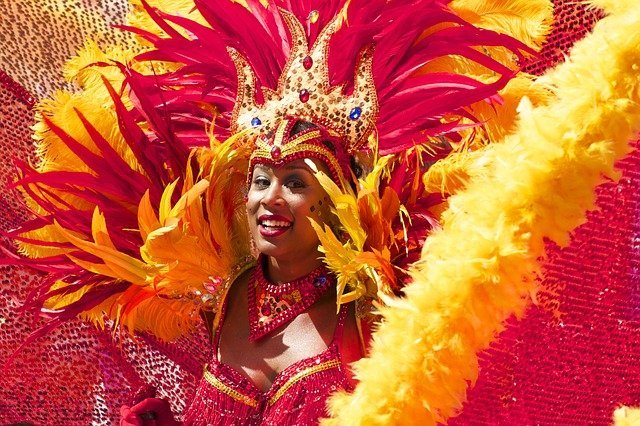
You are ready to be overwhelmed by the joy of Carnival? Then follow us to Rio de Janeiro, la cidade do samba and one of the world capitals of carnival celebrations. Not at all the carnival is born in Brazil in the 19th century, with the first masked dances from 1840 and the beginning of the great societies in 1855.
The contribution of the black and metish population, especially after the abolition of slavery, was decisive for the carnival carioca leading to the creation of Blocos, that is, the parades of persons forming the groups of which the parade is composed.
Before the introduction of masked dances, the fun consisted mainly of the launch of fragrant lemons (in the homes of children) and of any kind of liquid or flour (in the streets). After Independence, the masked dances arrived in Rio de Janeiro on the Paris model. The great success of these dances led to the introduction of other forms of fun, such as walks or promenades in the manner of the already almost extinct Roman carnival.
Meanwhile, the carnival proposed by the bourgeoisie was not the only one to reign in the streets of Rio de Janeiro; in parallel to the movement that wanted to introduce a feast with the characteristics of a worldly event, other types of manifestations set foot in the city.
TheEntruder (so it was called the set of jokes made on the streets during the carnival period) with its disorganized and spontaneous joy was not the only form of fun of popular carnival. Many black groups, called congadas (sing) congo) and cucumbis, took advantage of the relative freedom allowed during these popular holidays to obtain permissions from the police to give life to their representations.
Other groups formed by poor black people and small Portuguese traders (later known as Zé Pereiras) They began to participate in the festivities walking through the streets.
The mixture of these different groups has given rise to a carnival in which very different cultural events take shape, a characteristic that still distinguishes the carnival carioca.
In Rio de Janeiro, as well as traditional parades Blocos in the street, famous especially in the neighborhoods like Ipanema, Botafogo and Laranjeiras, is realized what can be considered one of the most important audiovisual shows in the world, the parade of the Schools of Samba. The place of the parade, the Sambódromo, is today an icon of contemporary carnival famous all over the world.
For the 2014 edition the parades of special groups of samba schools in Rio de Janeiro are scheduled for 2 and 4 days of March. For about an hour and twenty minutes, each school will exhibit the wonders of which the creativity of local artists is capable, staged with energy, splendor and movement. These groups, affiliated to the Independent League of the Schools of Samba in Rio de Janeiro, are distinguished by the splendor of their representations to which about five thousand people participate for each school.

