
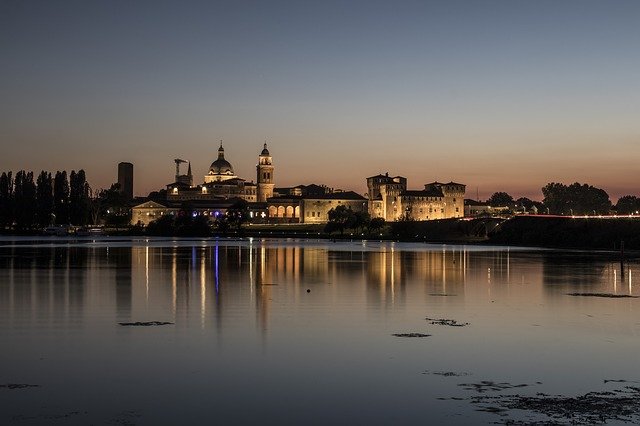
Doge's Palace with the fabulous Room of the Bride, masterpiece of Mantenga, alone worth a trip to Mantua. But if you do not yet know the land of the Gonzaga, then I suggest you take it easy and take it into account at least one weekend to explore slowly – also wanting on foot, by bicycle, or by boat on the lakes formed by the Mincio – the city sung by Torquato Tasso and recognized as a World Heritage Site by UNESCO.
Of course, any itinerary of discovery can only start right from Doge's Palace, in Piazza Sordello, so majestic, with thirty-four thousand square meters and over five hundred rooms, to look like a city in the city. Take advantage of this summer’s extraordinary opening and let yourself be enchanted by Room of the Bride, although, despite the name, it was not a wedding room but a high-representation room of the Gonzaga court.
The real surprise, then, is to see, between the leaves of a fake column, the head of the Mantegna, a self-portrait instead of signature. The imprint of the great Renaissance master is also found on a palace (now a hat shop), a stone's throw from the square Mantegna, whose façade is entirely painted, including putti, beams, ribbons. As art historian Arturo Carlo Quintavalle said, "it has the strength, the tension, the quality we find in the triumphs of Caesar."
And the almost perfect copy of the Triomphs (the originals are in Hampton Court in London) that the Mantegna made for Ludovico II Gonzaga are visible in Palazzo San Sebastiano, the city museum. It preserves remarkable cycles of frescos, such as the gonzaghesche enterprises of Crogiolo, Porcospino, del Sole. Not to be missed, the House of Brevi: at the centre there is a bunch of tickets that seem to be thrown from above, to symbolize luck.
Between the other treasures to discover of the city of Lombardy Round of San Lorenzo, in Piazza delle Erbe, the oldest town church (published at the end of the 11th century) of circular form, on the model of what Constantine had made in Jerusalem, in the place of the tomb, from which the Christ rose.
And again. Palazzo D’Arco (now the seat of the Foundation of the same name), an elegant neoclassical palace. It is almost as if it was still inhabited in a perfect counterpoint among ancient furniture, musical instruments out of the ordinary: the Tiorba to 18 orders of strings dated 1647 (if they currently know only three specimens worldwide).
Palazzo Te, designed by Giulio Romano, is another masterpiece of architecture, in perfect harmony with gardens, plastic and pictorial decorations. The Hall of the Giants, Horses and Psyche are the best known, but the berry is "the Apartment of the Secret Garden", a private place of contemplation and rest, decorated with paintings and reliefs allusive to the culture and virtues of the classical world.
Finally, not to be neglected places related to the great Nuvolari Tazio, the entrepreneur Mantovano Volante. From the Church of Sant’Andrea (projected by Leon Battista Alberti) where his funerals are celebrated with an immense crowd, passing through the house where he lived the last years of life, whose outer wall is inspired by the old Nurburgring box, where the automotive champion won in 1935.

