
Faenza what to see in the Romagna city famous for the ceramics of art: a guide to 10 attractions not to be missed.
"Faenza" or "Faience" is synonymous in the world of artistic ceramics: it is known as the majolica production center, a type of ceramics that has been produced for centuries in the many ceramic workshops of Faenza and exported worldwide.
Visiting its historic center you will discover a dynamic and lively artistic environment, which feeds on the important architectural and museum heritage of the city, but above all the ancient work of ceramic "boxes" and the presence of art schools. Here is an itinerary between art and ceramics to discover 10 things to see in Faenza.
Index of Article
Faenza what to see
International Museum of Ceramics
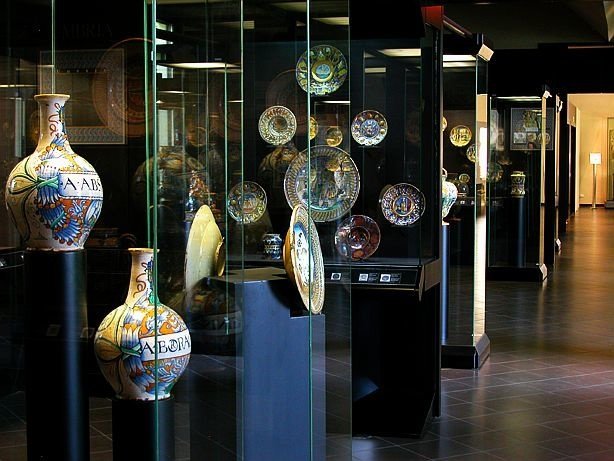
Our itinerary can only start from a visit to the museum dedicated to the most appreciated local art. The MIC – International Ceramic Museum founded in 1908, it represents an important starting point of the city path, as it welcomes in its spacious and bright exhibition halls unique ancient and contemporary collections in the world.
You can admire ancient works, which date back to the Middle Ages, dishes from all over the world and also some examples of modern art produced in the last century by eminent artists such as Chagall, Picasso and Matisse.
Among the most valuable objects, I point out above all a glass exhibitor with "Adoration of the Child Jesus" (1535) and a 16th-century anphora with Old Testament stories, although my favourite is the modern art collection.
Cathedral of Faenza
Founded in the second half of the fifteenth century by Bishop Federico Manfredi on a project by Giuliano da Majano, the Cathedral of Faenza has a three-nave architecture separated by eight arches supported by columns and pillars. In contrast to the unfinished façade, the interior decorations are of valuable work by local painters and sculptors such as Ferraù Fanzoni and Pietro Barilotti.
The main altar in baroque style is the work of Giuseppe Pistocchi, while on the vault stands a round in majolica attributed to Andrea della Robbia (1435-1525).
Portico dei Signori
Near the cathedral is the beautiful Portico dei Signori, built in the early 16th century. At the same time it is also the Clock Tower, although it was rebuilt after World War II. Right in front of the Portico dei Signori rises the beautiful Baroque fountain by Domenico Paganelli and Domenico Castelli.
Piazza del Popolo
Surrounded by arcades dating back to the second half of the fifteenth century, Piazza del Popolo is the administrative heart of the city. Of particular interest are the Palazzo Comunale and the Palazzo del Popolo of the XII century, which is accessed through an imposing staircase.
Originally home to the Captain of the People, it was the home of the powerful Manfredi family. Inside the building you can visit some of the finely decorated rooms in the first half of the eighteenth century by Vittorio Bigari and Stefano Orlandi.
Piazza Molinella
Following the so-called Voltone della Molinella, built at the time of the Manfredi, you arrive in Piazza Molinella, overlooking the famous Galleria dei Cento Pacifici, an extraordinary 18th century work by Giuseppe Pistocchi, decorated with decorations and statues by Antonio Trentanove placed in the niches.
Via Cavour
Walking along Via Cavour you will certainly not miss the sumptuous baroque buildings, built between the 18th and 19th centuries, which contribute to making this road one of the most elegant in the city. Among these, Palazzo Conti, Palazzo Zanelli, Palazzo Piani Pasi, but also the fourteenth-century Hospital Grande.
Church of Santo Stefano Vetere
Also in this quarter of Faenza is the Church of Santo Stefano Vetere, of which only the characteristic external octagonal structure remains. Originally a Manfredian church, it was probably built on a project by Giuliano da Maiano.
Nearby is the 18th-century Palazzo Laderchi which boasts a richly frescoed Feste Hall.
Ceramic workshops
Currently there are about forty ceramic workshops active in Faenza, especially in the historical center: visiting them means taking an original tourist-artistic route of the city. In fact, the real treasure chest where the secrets of the forms, the enamels and the decorations of the Faenza artistic tradition are preserved and handed down are ceramic workshops.
From the fourteenth to the present day, artists and artisans survive and continually reinvent the spirit, creativity and skill of the custodians of an ancient and modern art at the same time.
Carlo Zauli Museum
The Carlo Zauli Museum is untouched, in the ancient workshop of the master, the fascinating creative and intimate atmosphere of the artisan workshop: a typical atmosphere of an "old work" that is found, unchanged, in the many ceramic workshops that meet in the city.
Pinacoteca Comunale di Faenza
The oldest city museum the Municipal Gallery of Faenza is housed in the historic Palazzo dei Gesuiti. Its foundation dates back to 1797 and is among the most important ofEmilia Romagna: it boasts important collections of paintings by Faenza and Romagna artists, ranging from the 14th to the 20th century, including an interesting collection of modern art.

