
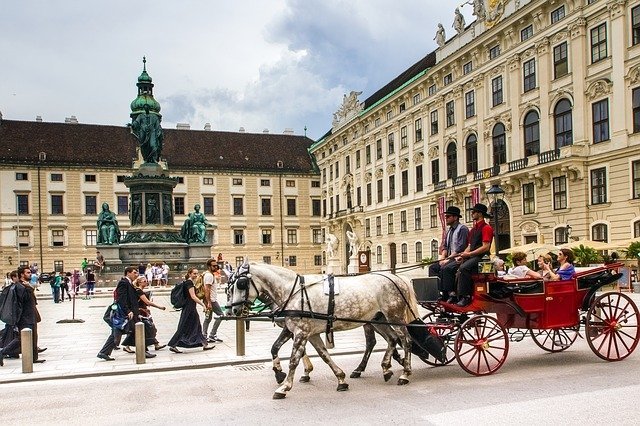
In 2015 the 150th anniversary of the Ringstrasse, the sumptuous avenue over 5 km long around the centre of Vienna and represents a suggestive parade of attractions. A good excuse to visit the Austrian capital and take a walk through the magnificent palaces and public buildings built in the second half of the nineteenth century that are a real mine of architectural and artistic details. Just think about the decorations of the facades of the buildings, the setting of portals and staircases of buildings, or even the sculptures of the buildings.
This public space, defined by Edmund de Waal ("An inheritance of ivory and amber") the greatest in Europe, is caratized by a wide variety of styles. The urban planning formula provided a set of representations consisting of public and private buildings, deliberately arranged next to each other.
The Ringstrasse has always been the mirror of the great transformations Vienna: its construction constituted a urban revolution, in its living rooms were worn the newest fashion creations and it was discussed by controversial artists, and today is the most versatile offer of the city: from classic shows to the State Opera of Vienna to the sports event Vienna City Marathon, up to the extravagant Life Ball.
The Ringstrasse was inaugurated on 1 May 1865 by Emperor Franz Joseph I, where once the city walls protected the imperial center of Vienna from enemies. The aim was to create here the largest urban project in the city: buildings of imperial representation and symbols of an increasingly solid democracy alternated with buildings of the rising bourgeoisie.
Among the monumental buildings for administrative, governmental, cultural or economic use located along the Ringstrasse The State Opera, the Burgtheater Theatre, the City Hall, the University and Parliament are located. The Museum of Natural History, the Kunsthistorisches Museum – Museum of Art History – and the Neue Burg wing, an extension of the Imperial Palace Hofburg, were an element of an architectural project aimed at underlining the claim to the sovereignty of the Habsburgs.
The Imperial Forum had to connect the Hofburg with the two twin museums erected to accommodate the imperial collections and to push to the imperial stables (where today is the MuseumsQuartier cultural area). The second wing in front of the Neue Hofburg (now Heldenplatz square) was never realized, and the imperial hole remained incomplete. The Ringturm skyscraper by Erich Boltenstein, inaugurated in 1955, is one of the few truly modern buildings along the Ringstrasse.

