
Travel to Israel, discovering the 5 UNESCO sites in Galilee: ♪, Necropolis of Bet She’arim, Caves of Tabun, Jamal, el-Wad and Skhul, Baba and Bahai Gardens in Haifa, la Old town of Acre.
Perhaps you did not notice, but among the 24 new sites included this year in List of World Heritage SitesUnesco there is also the Necropolis of Beth She’arim, Israel, a complex of judaic catacombs dating back to the 2nd century BC. At the time it was the main place of Jewish burial outside Jerusalem and now it is an archaeological site made particularly interesting by the abundance of decorations and inscriptions in Hebrew, Greek and Aramaic found on its walls. An underground labyrinth consisting of about thirty catacombs located inside caves, the largest of which is articulated in over 20 rooms and houses dozens of sarcophagi, now empty.
Index of Article
Israel, the 5 UNESCO sites in Galilee
That's how they jump nine UNESCO sites in Israel5 of which are in Galilee, the fertile green and mountainous region in the north of the country, and can represent the stages of a fascinating itinerary between history, art and culture, immersed in beautiful natural landscapes.
♪
Leaving Jerusalem, head north to reach the ♪ Biblical of Megiddo, one of the most extraordinary archaeological sites in the country, located on an artificial hill (a ♪, in fact) composed of about twenty overlapping layers, corresponding to as many settlements datable from 7000 to 500 BC. I tels of Megiddo, Hazor and Beer-Sheva, are among the most interesting of the more than 200 ♪ found in Israel, also for their strong bond with biblical events.
According to the Old Testament, in fact, Monte di Megiddo would be the place of Armageddon, the final confrontation between the forces of good and evil of which the Apocalypse narrates. In fact today it is a quiet and particularly suggestive place, inside a national park, although in the past it was the scene of important battles for its strategic position along the "via maris", one of the main Roman commercial routes. Highly spectacular are the ruins of the City of the Carri wanted by King Solomon and the ingenious water system dating back to the 9th century BC with a well dug in the deep rock 30 meters.
Necropolis of Bet She’arim
After the visit you can reach the Necropolis of Bet She’arim, located about twenty kilometers south of Haifa, and then continue towards Site of human evolution at Mount Carmelo with the caves of Nahal Me’arot/Wadi el-Mughara. The great archaeological park on the western slopes of Monte Carmelo is one of the places where the first traces of human presence were found in South-West Asia, dating back to about 500,000 years ago.
Caves of Tabun, Jamal, el-Wad and Skhul
In caves of Tabun, Jamal, el-Wad and Skhul, spread over a territory of about 54 hectares, were found the only evidence of the existence of both human beings of Neanderthal and the first modern men within the same cultural frame of the Middle Paleolithic. In addition, the research carried out in these places for over 90 years has been able to study the passage from a hunting and harvesting lifestyle towards a oriented agriculture and grazing.
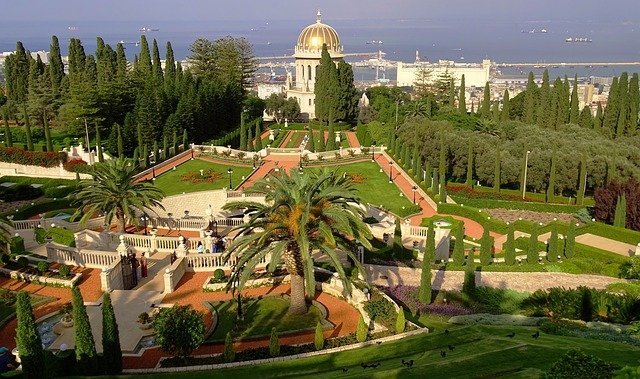
Baba and Bahai Gardens Haifa
Returning to Haifa, you can stop at Babaone of the two most important sanctuaries of the Baha’i faith (the other, the Baha’u’llah is located in Acre), founded by Baha’u’llah in the 1800s and based on the uniqueness of God and the pursuit of harmony between science and religion. The temple, surrounded by beautiful gardens is a destination every year of thousands of followers from all over the world as together with other buildings, monuments and sacred sites distributed in seven distinct locations between Haifa and Western Galilee represent the highlights of the traditional Bahá'í pilgrimage.
Old town of Acre
Our journey continues to the north, to the Old town of Acre, the ancient capital of the Crusaders in the Holy Land and one of the most beautiful places Israel. Take time for a walk through the alleys of the fortified historic center in the Ottoman era, which encloses the picturesque Arabic suq, mosques, khans and Turkish baths, and then climbs to the walls to admire the magnificent panorama ranging from Haifa to Mount Carmelo, valleys of Galilee.
But the real surprise is Fortress of the Hospitallers, a grandiose complex of several buildings, partly underground, dating back to the time of the Crusades and seems to have also hosted San Francesco and Marco Polo during their trips to the Holy Land. A magical place where the millenary history of the city is perceived.

