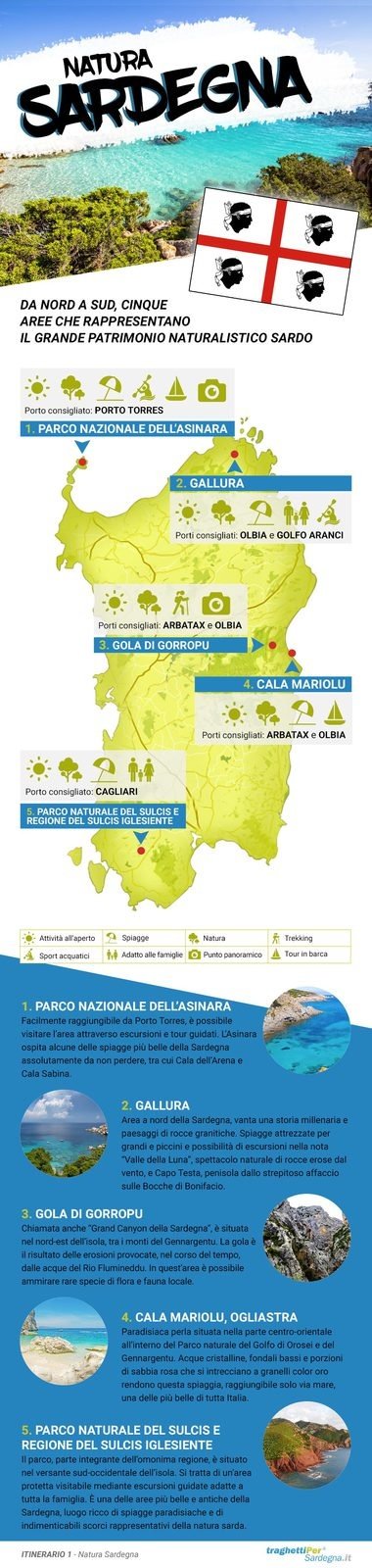
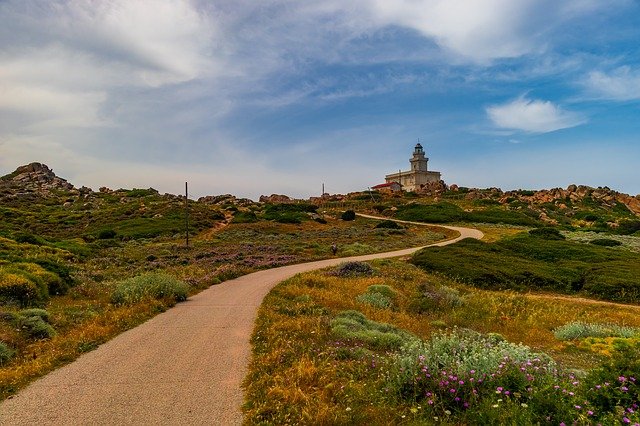
We discover the Gallura, the area surrounding Olbia, the green heart of Sardinia easily reached by ferry.
In the far north of Sardinia, behind the golden beaches of the coast, the Gallura is a region made of culture and traditions, crafts and ancient flavors, men, villages and a still wild nature. Reaching this corner of the island is easy thanks to the many Ferries to Sardinia that connect the ports of Livorno, Genoa and Piombino with Olbia and Porto Aranci.
Index of Article
What to see in Gallura
The Gallura is a land to be discovered at a slow pace, without haste, by car, motorcycle, bicycle, or on board the Green train departing from Palau for a journey of past times between cork, flocks of sheep pasture and granite hills, destination Tempio Pausania. First, however, I recommend you to explore this coast of Sardinia, with the islands of La Maddalena immersed in a sea to envy Polynesia.
The best point to admire them in all their splendor is Head of Bear, where the wind carved a huge sculpture that recalls, in fact, the shape of a plantigrado.
Leaving the coast, the green train immerses itself in the stain that has the colors and aromas of myrtle, erica, corbezzolo and lentisco. First stop, Arzachena, whose territory is actually an archaeological museum en plein air: among megalithic monuments, tombs of giants and necropolis there is also the classic Sardinian nuraghe, which dominates the plain from the top of the Capichera hill.
St. Anthony of Gallura
In Sant’Antonio di Gallura, dominating the surrounding landscape is instead the tomb of giants Longhi, the most important of the whole island, as well as one of the best preserved. These are funerary monuments similar to dolmen, so called by popular fantasy for their cyclopic size. If you are lovers of excursions you can walk up to the summit Monte Santo, which just over 600 meters, and conquer a panorama that stretches to the sea.
After Sant’Antonio di Gallura the landscape changes and the railway now runs along the shore of the Liscia artificial lake. A secluded valley is a pilgrimage destination for lovers of naturalistic curiosity: it guards it’s not, the oldest and most majestic olive grove of the whole of Sardinia, aged over 2000 years.
Although they are actually cork oaks to dominate the landscape as they approach Calangianus, where there are still craftsmen who create objects of domestic use with soft bark.
Valley of the Moon
Luras, tiny village on the Limbara plateau, boasts an archaeological heritage of all respect. In fact, there are four Sepulturas de zigantes that go back to the Neolithic.
We're in Valley of the Moon, dotted with massive granite shaped in centuries from rain and wind. Pto them you owe the name ofI'm sorry. area from the lunar aspect, especially when it comes lightinga by the reflected light of our satellite and then It seems to be on another planet.
Although it is located not far from the resorts more mountainous and touristic baths Sardinia, the Valley is still an unspoilt environment, rich in vegetation.
Pausania Temple
Then we come to the noble Pausania Temple, ancient capital of the judicature of Gallura that preserves a historic center with churches and beautiful palaces Gentilezi in gray granite embellished with wrought iron railings. Not at all is called "the stone city".
Around the main square, in addition to the Palazzo Comunale are concentrated the most important monuments, while in the adjacent square you can visit the cathedral dedicated to San Pietro with portal and bell tower of the fifteenth century, the oratory of the Rosary and the church of Santa Croce.
They say Pausania Temple is famous for its waters, the light and diuretic ones of the sources of Rinagghju, which flows into a shady valley just outside the country. But if you love drinking well, you don't have to miss a bet on Winery Gallura to taste and buy the excellent wines of the area such as Vermentino, solar just like this corner Sardinia.
If you have time, you can continue towards western coast of Gallura until Castelsardo, a medieval village on a promontory in the middle of the Gulf of Asinara, which as you can easily guess takes its name from the massive Genoese foundation castle. Walking through its streets you will discover small treasures of art, such as the cathedral of Sant’Antonio Abbate and the "Black Christ", kept in the Church of S.Maria.
Aggius
A stone's throw from the suggestive Valley of the Moon, full of testimonies that date back to the Neolithic, Aggius is one of the centers oldest in Gallura. The country is cared for Flag orange, tourist-environmental quality brand assigned to the villages that stand out for the quality of hospitality, environmental sustainability and for the protection of artistic and cultural heritage, giving a travel experience authentic to visitors.
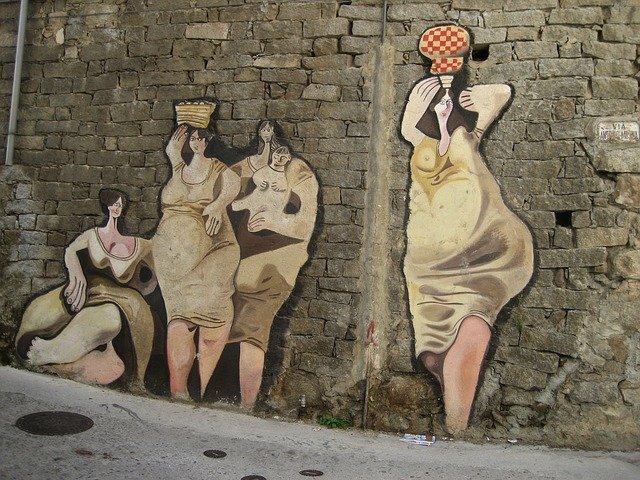
But not only. The village is also one of the custodians of Sardinian traditions, which keeps alive the crafts of weaving and the processing of cork, iron and granite. The typical stone of Gallura is used in particular for the construction of houses and churches of the old town, to be visited following a contemporary artistic path between murals and doors painted in bright colors.
Don't miss the visit MEOC – Olive Ethnographic Museum Cannas, which encloses the historical memory of the village and also offers handicraft workshops of carpet weaving.