
Burgundy what to see: a fascinating itinerary that touches 8 UNESCO sites and crosses millennia of history, from prehistory to contemporary age.
With 8 UNESCO sites scattered on its territory, the Burgundy is, together with Occitania, the region of France which boasts the highest concentration of UNESCO sites listed in the World Heritage List: Notre-Dame Church in Charité-sur-Loire, Basilica and Hill of Vèzelay, Cistercian Abbey of Fontenay, the "Climats" of Burgundy, Palafitticoli Sites of the lakes of Chalain and Clairvaux, Grande Salina di Salins-les-Bains, Saline Reali of Arc-et-Senans, Cittadella and Fortifications These are the stages of a fascinating itinerary that crosses millennia of history and an incredible variety of landscapes, including obviously the legendary vineyards that produce the prestigious wines of Burgundy, renowned all over the world.
Index of Article
Burgundy what to see, 8 UNESCO sites not to be missed
Notre-Dame Church in Charité-sur-Loire
The journey begins along the banks of the Loire, in the city of Charité-sur-Loire which with the Church of Notre-Dame is one of the gateways to the discovery of the world heritage of the BourgogneFranche-Comté region. In 1998, the church of Notre-Dame is included in the UNESCO World Heritage List as a milestone in the road of Santiago de Compostela in France. The pilgrims used to take advantage of the "charity of the good fathers", a tradition that gave the name to the city.
In the middle of the 11th century, the Abbey of Cluny founded the priory of La Charité and soon the building assumed a key role in the expansion of the cluniac order. In the 12th century, the church of Notre-Dame measured 120 meters in length; the bell tower of Sainte-Croix had a height of 72 meters and the nave of 27 meters.
The fame of the church of Notre-Dame is mainly due to the richness of its sculpted decoration. The columns and capitals of the deambulatory, the choir's beast and the high arches bear witness to the richness of the cluniac inspiration.
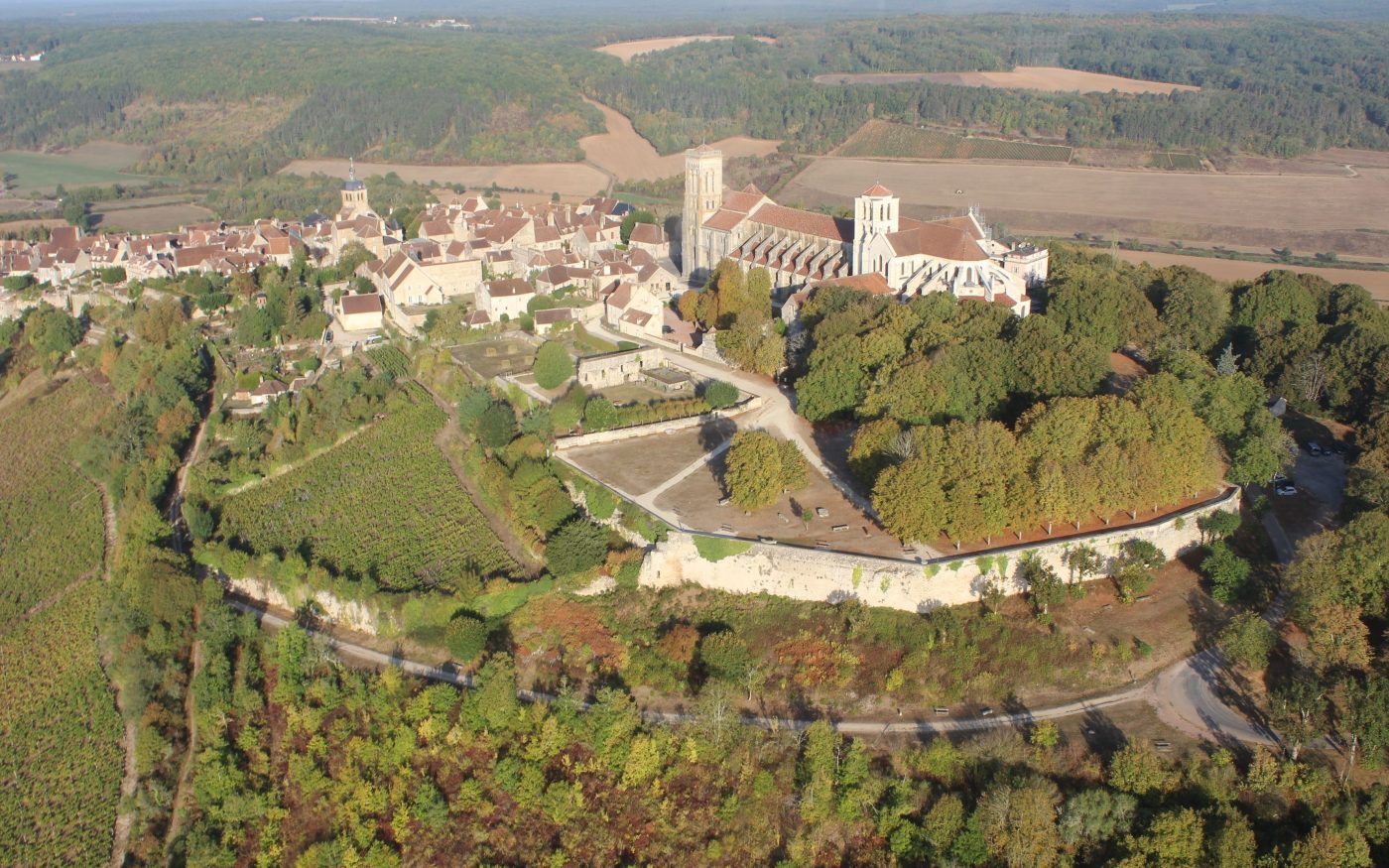
Basilica and hill of Vèzelay
At the gates of the Morvan Natural Park, bathed by the Cure River, the Vézelay Hill (in the past called Mont-Scorpion and "eternal hill") was the scene of the historical founding events of the Bourgogne in the 9th century. The basilica of Santa Maria Maddalena, or basilica of Vèzelay which dominates the "eternal hill", is a distant echo.
Vézelay was conceived as a lighthouse of Christianity and the Benedictines (committents of the abbey dedicated to Mary Magdalene and of which they claim to preserve the relics) welcomed and directed many pilgrims and crusaders to Rome, Jerusalem and Santiago de Compostela.
The basilica and the Vézelay Hill in Burgundy are among the first French goods listed in the World Heritage List in 1979 and then again in 1998 for the Santiago de Compostela Way. Place of history, spirituality and art, "archetype" of pilgrimage cities, an important commercial site surrounded by walls, whose restoration today represents an important challenge, Vézelay reveals to visitors, the luminous testimony of the ancient abbey church, with its superb sculpted decoration of the 12th century.
Cistercian Abbey of Fontenay
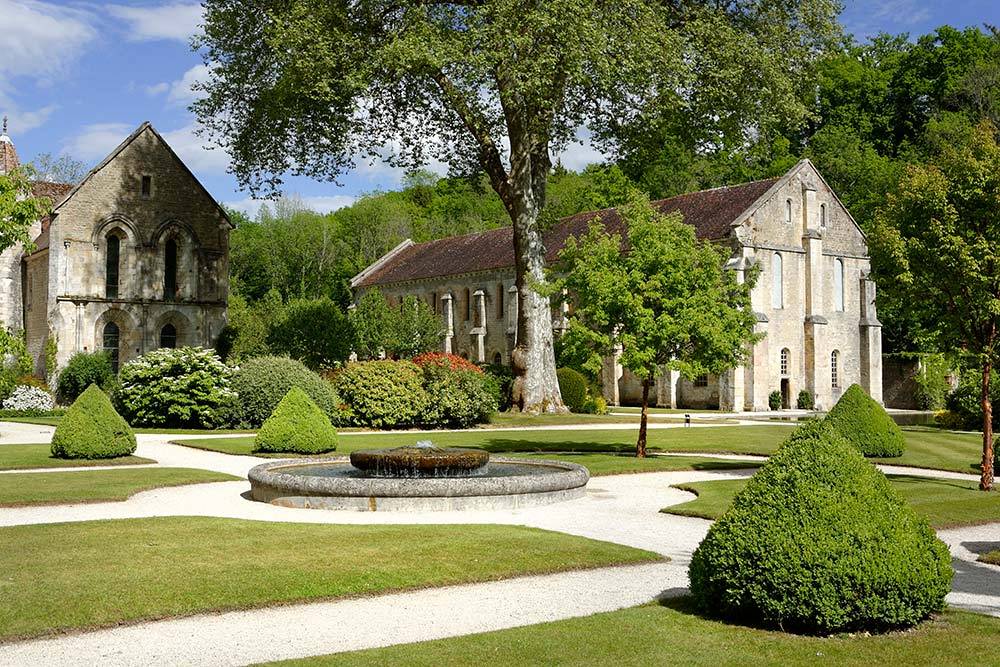
Further north, at the bottom of a green valley, you can see one of the jewels of the French Romanesque heritage: the Cistercian abbey of Fontenay, the only French abbey completely intact. Founded in 1118 by San Bernardo, the Abbey of Fontenay in Burgundy is one of the oldest Cistercian monasteries in France.
The Romanesque architecture gives a strong homogeneity to the 12th century conventual buildings complex, which reach us intact through over nine centuries of history.
Following the rigorous plan of St. Bernard, you can discover in the order the church, the dorm, the cloister, the capitular room, the scriptorium, the refectory and the forge.
The ideal extension of the visit to the rooms of the abbey, the large French-style gardens and the new landscaped gardens reveal a wide variety of plantations, centennial trees and numerous water mirrors. After the gardens, the Fontenay valley envelops the abbey on an area of over 1200 hectares of forests and rivers, offering evocative and always changing views according to the seasons.
The "Climats" of Burgundy
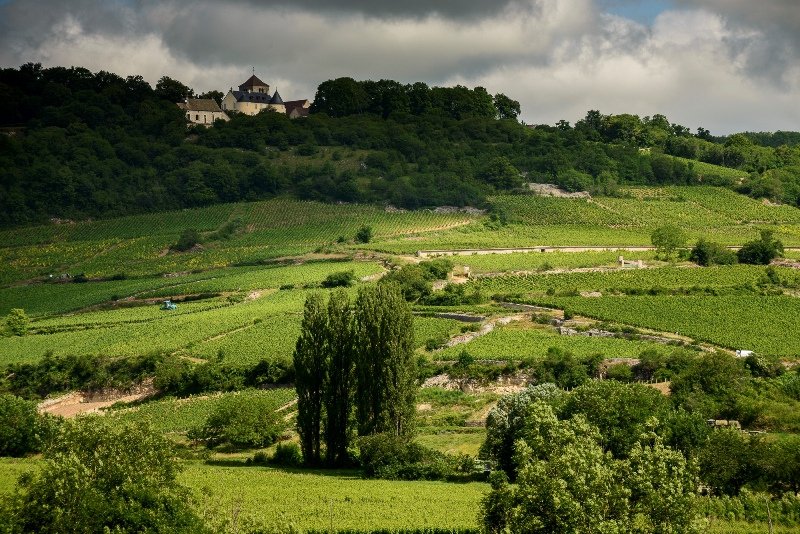
In the south-east direction, you will cross the famous hills of the "Climats" of Bourgogne, a territory where the savoir-faire and the wine tradition have been handed down for centuries with respect and passion. The term Climat must not deceive: in Burgundy, it does not indicate the weather, but a wine territory. A Climat is a clearly defined and named vineyard parcel, where a unique wine is produced, which bears its name. Montrachet, Romanée Conti, Chambertin, Les Cailles, Les Amoueuses, Clos des Mouches... there are over 1200 Climats on the heritage site, between Digione and Maranges, south of Beaune.
The Bourgogne Climats are a model of local viticulture for the whole world. The wine growers and the owners of vineyards have acquired the knowledge of the territories, the savoir-faire and the viticultural art over the centuries, starting from the Early Middle Ages.
For 2000 years, the culture of the vine has gradually created a unique and diversified heritage: the walls and cabottes (stone or wood constructions in the middle of the vineyards), the viticultural environment of the villages and the great monuments of the cities of Dijon and Beaune. This architectural heritage is the concrete expression of the monks, the Dukes of Valois-Bourgogne, merchants and winemakers who created and protected the Climats, creating a fascinating landscape.
Palafitticoli Sites of Chalain and Clairvaux Lakes
Continuing east, the reliefs are accentuated, the slopes are covered with pine forests: there is no doubt, you are in the Jura. On the shores of the Chalain and Clairvaux lakes, humanity seems to assume all its meaning: here man has been able to adapt with ingenuity to the particularity of the environments. Since June 27, 2011, prehistoric sites of the Alps are listed in the UNESCO World Heritage List as a transnational serial site.
The archaeological space of Clairvaux-les-Lacs covers 40 years of archaeological research and investigations around the lakes of the Jura, exposing the reconstruction of a lake habitat and the findings brought to light.
Great Salina of Salins-les-Bains
Along sinuous roads you will reach the Salins-les-Bains valley, with its vertiginous view. the Great Salina of Salins-les-Bains testifies to 1200 years of production of ignigen salt (i.e. obtained by artificial evaporation).
This unique medieval industrial site in Europe, as well as one of the oldest in France, still today preserves exceptional technical and architectural elements, witnesses of a millenary art that from the 8th century exploits naturally salty sources.
Built in the 13th century to protect salt water wells, this underground tunnel, similar to a cathedral at the service of salt processing, has immense times of the length of 165 meters.
And this is only a part of a vast fortified industrial complex, which extends over a surface of 2 hectares, built on order of the Dukes of Bourgogne in the Middle Ages when the Great Salina became a large plant and contributed to the development and prosperity of Salins-les-Bains. In the heart of this great underground space, a 19th century barbell, moved by a large hydraulic wheel, activates a water pump that is still working today.
Real saline of Arc-et-Senans
On the steps of the smugglers of the salt, once arrived at the end of the royal avenue, will open before you a vision, that of a genius architect, Claude-Nicolas Ledoux, who did not design only a factory but a real ideal city: you arrived at the Royal Saline of Arc-et-Senans.
The unique architectural complex, commissioned by King Louis XV and written in the UNESCO World Heritage List since 1982, the Royal Saline of Arc-et-Senans are the masterpiece of the architect Claude Nicolas Ledoux.
Built between 1775 and 1779, this factory for the production of salt combines functionally and symbolically 11 buildings which, after the shutdown of production in 1895, risked destruction several times. Emblem of the lighting style architecture, the Saline Reali are first and foremost an integrated factory, where almost all the working community lived. They are also a theatre, which has as stage the "Bernes" (padiglioni used for the evaporation of salt water) and the "Maison du directeur" (the residence of the director of salt).
Last but not least, they are a plastic expression thanks to the refined use of buggy facades, columns, pediments, circles and mansars all conceived to be animated by the path of the sun. The architectural plan of the Royal Saline, their history and renovation work make it a unique monument to the world, reflecting our roots and the imprint of that time.
Citadel and Fortifications Vauban in Besançon
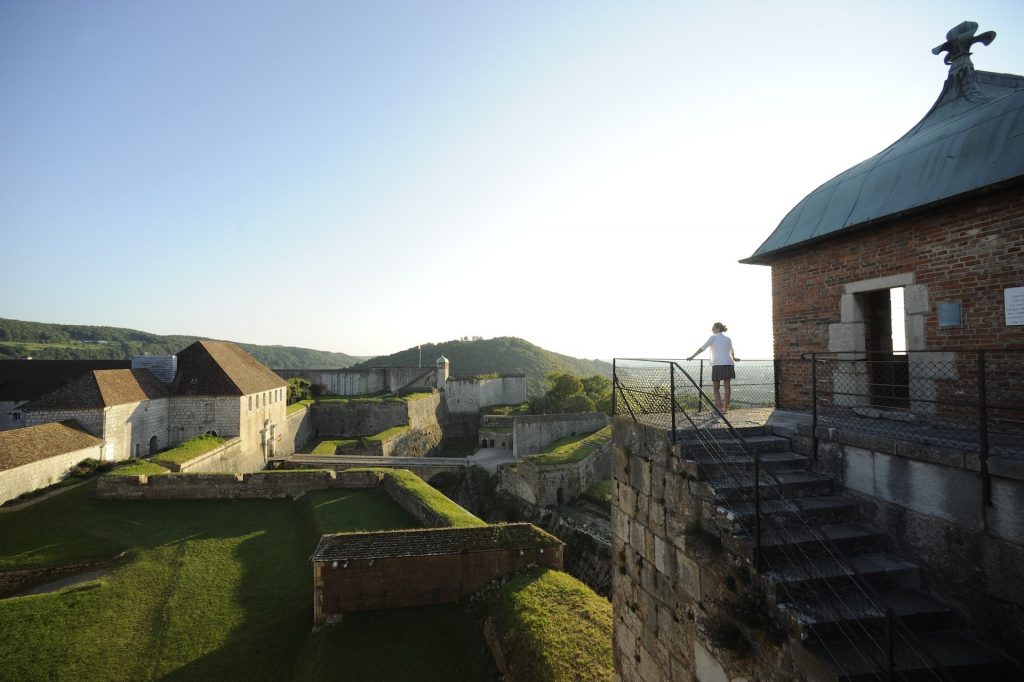
In the capital of Franche-Comté, there is one of the jewels of Ledoux, the Citadel of Besançon, an inexpressible fortress that proudly dominates a beautiful and rich city of history.
The history of Besançon and his Citadel is intimately linked to that of the architect Vauban, who designed fortifications in the 17th century, under King Louis XIV. Registered in the UNESCO World Heritage Site in 2008 are a great example of military architecture. The Citadel, a central element of the fortifications, is considered one of the most striking in France.
Perched on an anteclinal overlooking the city from over 100 meters high, from its walls you can admire exceptional views of the historical center and the omnipresent surrounding nature. The Citadel is a unique jewel in its kind, which surprises visitors for its many facets, on an area of almost 12 hectares.
Notre-Dame du Haut Chapel in Ronchamp
The itinerary ends in Ronchamp, where you can visit the chapel of Notre-Dame du Haut overlooking the valley, by architect Le Corbusier, one of the most influential French architects of the twentieth century.
An unusual, timely place that stimulates reflection and leaves no one indifferent. The chapel of Notre-Dame du Haut, the refuge of pilgrims, the house of the chaplain and the pyramid of peace form as a whole an emblematic place of modern architecture in Ronchamp.
These four buildings, together with 16 other sites, the result of the genius of Le Corbusier, have been listed in the UNESCO World Heritage List since July 2016. Built in 1953 and opened in 1955, the Notre-Dame du Haut chapel launched strong reactions. If, on the one hand, the detractors compared it to a bunker or a mosque, its supporters immediately caught the beginning of an authentic architectural revolution.

