
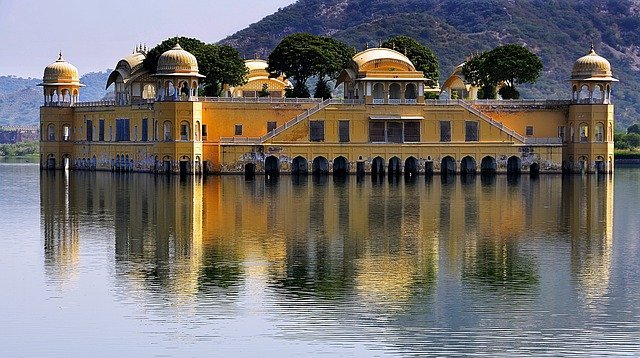
You leave for India aware of going to discover something very different from our way of living and posing towards reality, going not only to admire the magnificent historical palaces, but making yourself fully enveloped by a whirlwind of colors!
The travel to India starts at New Delhi airport. Exit from the terminal immediately immersed in the strong colors of the writings of the shops of the bazaars. Even without bright signs, every writing that appears on the front of the entrances is made using access colors to attract the attention of passersby.
New Delhi is a city surrounded by greenery, dotted with unique monuments such as the Qutb Minar, the richly carved minaret became the symbol of India, the UNESCO site of the Tomb of Humayun, considered the precursor of the Taj Mahal, and the India Gate, where every Indian at least once in his life comes under this triumphal arch symbol of their national unity.
The real travel to India beginning to enter into what is perhaps the most known region, the Rajasthan, or the state of the kings. Already from the name it is understood that in the area have arisen in the course of several magnificent strong kingdoms and palaces. What you may know less is the context surrounding these monuments.
The first stage in Mandawa leads to the discovery of the magnificent "Haveli" palaces, built by the British lords at the beginning of the last century. A waterfall of colors invests you when you admire the walls of these houses.
Despite the paintings on the walls are not all preserved to the best, you can imagine the splendor of these houses all rigorously decorated with representations from the most varied motifs, from religious themes to scenes of daily life of the colonizers and, as a pleasant surprise, also frescoes depicting Venice.
The village of Mandawa offers the opportunity to see the life of an Indian village. Among the rough roads of people stands above all a "strange" presence: the cows. The cows, as you know, are sacred in India and the inhabitants do not care to make them stand in adequate stables. The animals walk alongside the people in the streets, with calm and peaceful muzzle, definitely more than the traveler who has yet to get used to their constant presence.
Along the way to the next stop of the trip, Jaipur, is known to be surrounded by colorful shawls that turn in the air. They are the veils of the beautiful women's sari who sits behind the husbands' scooters are accompanied around. All women in sari reflect femininity; with a single piece of cloth the Indians create beautiful dresses, adorned with multicolor bracelets.
Index of Article
Jaipur the pink city
The color that welcomes those who come to Jaipur, the capital of RajasthanIt's pink. Once red, the buildings in the central area of the city had been painted this shade from the maharaja to accommodate the English prince Alfred in the early 1800s.
Today what remains of the shade is a bright rose, but the buildings re-evoke the size of a time. Here is the incredible Palazzo dei Venti (Hawa Mahal) built so that women could see from the richly carved grates of construction the activities of the underlying market. The final result is a beautiful facade adorned with numerous windows!
The strong piece awaits visitors outside the city, near the village of Amber. They are the yellow colors of the Amber Fort carved on the green hills that attract a crowd of tourists. He departed behind elephants to feel like the ancient maharajas when they entered the palace to arrive at the entrance of the fort.
Inlaid rooms with mirrors, hanging gardens and magnificent rooms of public hearings complete the magnificence of the palace. Jaipur is also known for jewelry and carpet processing. Interesting to see how these colorful carpets are made, strictly making a knot at a time with silk or wool. This means months of work for one piece.
The Rajasthan it is not only palaces and strong, it is also sacredness and culture. In Pushkar there is the only temple in India, and one of the few in the world, dedicated to the god Brahma. Millions of pilgrims arrive each to worship the god of creation for Hinduism.
We mix between the adorable crowd praying at the temple and among the devotees who do ablutions in the sacred lake of Pushkar. The city is known for the presence of many yoga schools; different Europeans decide to find their spirituality here. But in addition to the sacred is not missing the profane, among the streets a lot of gingilli to buy as memory await you. Interesting to admire the natural colors with which women use makeup and paint tattoos at the age.
Taj Mahal the white temple of Agra
It starts at the time of one of the seven wonders of the world: in Agra there is the famous Taj Mahal. And if it is so famous there will be a reason! The pure and candid white that welcomes visitors from the entrance stands in all its magnificence on the banks of the Yamuna river. A heavenly and heavenly vision.
Inside the Taj Mahal there is a unique piece of art. The cenotaphs of the kings buried in the crypt are surrounded by a marble grate set with precious stones. One piece!
In Agra you have the pleasant surprise to discover that not only Carrara is famous for marble. In the city there are industries working the white stone from the caves of Makrana, in Rajasthan, A brilliant and pure marble with which are made tables, boxes, vases, statues...
Although the weight of sure does not allow to take home too large objects, small marble memories, such as undergrowers or jewelry, are the right memory of Agra to associate it with the marble white of the Taj Mahal.
Near Agra is the UNESCO site of Fatehpur Sikri, where the strong red sandstone bears witness to the richness of the Moghul dynasty that reigned on the area.
The greatness in the building is also in its architecture: Persian architectural elements, Muslims, Hindus and Christians were all used together to underline the religious tolerance of the rulers. Still todayIndia It is from this point of view one of the most secular countries: all religions of the world are practised in this state.
After a train journey from Agra you reach Orcha, home to majestic palaces. The stone still reveals the ancient original turquoise colors, but the most amazing thing is that one of the 4 buildings present was used for only one night and then abandoned.
Kahjuraho dominates the color of sandstone. The site is famous for the temples of the 10th century AD ably enriched with numerous statues with finely designed bodies. Kahjuraho is known for the great erotic figures found among the temple decorations. Love is enhanced with prayer and devotion to the gods.
Varanasi spirituality and golden temples
The real India, that of the whirlwind of colors, smells and sensations can be seen in one place, in the sacred city of Varanasi. At least once in life a Hindu must go to make the ablution in the sacred Ganges river that bathes the city. To die in Varanasi means for these people no longer to reincarnate, but despite the presence of the pires active 24 hours, this is far from a dead city.
Varanasi is synonymous with chaotic. The streets are covered by a carpet of people moving: on foot, by bicycle or in rickshaw, in motion or in tuk tuk, in the car... without forgetting the presence of the sacred cows. Two are the important moments that make the life of the city live as a perennial rite. In the evening the ceremony of seven arms pays tribute to the river god and at dawn pilgrims come to the Ganges to dive.
The waters so inviting for devotees are not for foreign visitors, their gray color certainly does not invite to dive. But it is in that emergence that the Indians revive their beliefs and their millenary culture.
It is going to pray to the golden temple, so called for the dome covered with this precious metal, that the faithful pray for a better future, aware of being only passing on the earth, that sooner or later also the cycle of reincarnation will end up reaching what is called Nirvana for Buddhists, Svarga for Hindus and Paradise for Christians.
After ten days of tour you return home with a heavier luggage, not only the suitcase weighs more for the memories that you bought during the holiday, but also your cultural baggage has enriched having learned to know India by enveloping itself from its color whirlwind.
Sabrina Ferrario travel report
Travel organized by Eastbound

