
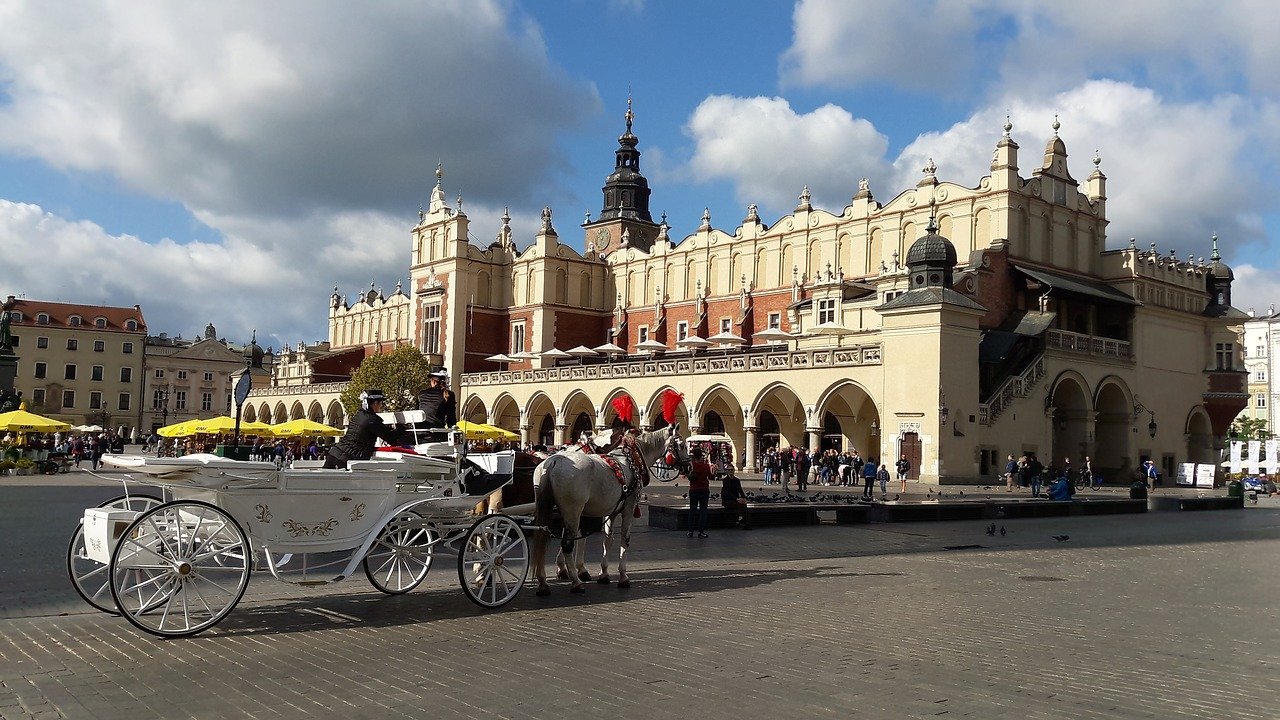
Krakow and Malopolska what to see: a heritage of 8 UNESCO sites and 6 national parks makes the Małopolska region the cradle of Polish culture and tradition. A trip to the "Little Poland" can only start from Krakow, the capital of the region, a city rich in history, with numerous attractions to visit.
Index of Article
Krakow what to see
World Heritage Site since 1978, Krakow is Poland's most important artistic and cultural centre. Ancient monuments, admirable works of art, an architecture testimony to Polish civilization and the oldest university in the country, as well as being one of the oldest in Europe, make this city a place full of history. Even the most demanding art lovers will not be disappointed because it is a culturally very active city.
European Capital of Culture in 2000 and awarded by UNESCO of the title of City of Literature in 2013, Kraków is home to numerous museums and art galleries, including the National Museum of Krakow, the Museum of the Czartoryski Principles, the Museum of Art and Technology Japanese Manggha, the Museum of Pharmacy (a historical pharmacy in the former Jewish ghetto, symbol of resistance against Nazism), the Museum of Contemporary Art of Contemporary Art in Krakow
The old town is mainly known for the high number of churches, almost thirty, present on its surface, such as the Romanesque church of Sant’Adalberto, one of the oldest in Krakow. The Market Square (Rynek) is the largest European medieval square, while the royal road is the ancient way of passage of the solemn processions of kings.
Wawel Castle
On the hill of Wawel, seat of ecclesiastical and secular authorities since the Middle Ages, stand the Royal Castle of Wawel and the Cathedral of Saints Stanislaus and Wenceslas, inside which are buried the Reals of Poland and other illustrious Poles. The Jewish district of Kazimierz, along with the ghetto in Vienna, is the best preserved Jewish area in Europe. Inside there are 2 cemeteries and 6 synagogues, including the synagogue of Remuh, one of the three oldest in Europe. Nowa Huta, the metallurgical complex of Lenin's foundry, is the symbol of Polish industry and resistance to communism.
Wieliczka Salt Mine
Just 17 km from Krakow we find the salt mine of Wieliczka, consisting of a long underground maze of caves and corridors dug in the salgemma, including the cave with the chapel dedicated to Santa Cunegonda, with a capacity of about 500 people.
Sanctuary of Kalwaria Zebrzydowska
The shrine of Kalwaria Zebrzydowska, the main place of Marian worship in Poland after Częstochowa, is called the "Polish Jerusalem" for the vastness of its size, which, along with the Via Crucis, has 42 elements.
Auschwitz-Birkenau
A short distance from Krakow and therefore easily visitable on the day, the concentration camp of Auschwitz-Birkenau, the largest lager created by the Nazis during the Second World War, is the symbol of terror and extermination of the twentieth century. Originally conceived as a field of work, it later became the largest slaughter site designed by the Third Reich, where 1,5 million Poles and prisoners from all over Europe lost their lives, mostly Jews. Do not miss a trip to the Auschwitz-Birkenau camp, called Monument of the Polish People's Martyrdom and other Peoples.
Małopolska what to see
The church of San Michele Arcangelo di Dębno is one of Poland's oldest wooden churches and has its interior paintings decorations of incredible splendor, as well as a precious furniture. In UNESCO list of the sites present in Małopolska are part of three other churches: the church of San Leonardo di Lipnica Murowana, dating back to the fifteenth century, the church of San Michele Arcangelo di Binarowa, late Gothic church in larch with pictorial decorations inside the sixteenth and seventeenth centuries, and the church of SS. Filippo and Giacomo di Sękowa, 155 km from Krakow.
From a naturalistic point of view, the area of the region is 53% in natural protection, with 6 national parks, 11 landscape parks, 10 protected landscape areas and 84 nature reserves, as well as 2.189 natural monuments. The areas of the Babiogorski and Tatrzański National Park are considered UNESCO biosphere reserves. Don't miss Babia Gora National Park and Gorczański National Park.
Itinerary of Lignea Architecture
In the Voivodeship of Małopolska you can also take a fascinating tour to discover enchanting Christian and Orthodox churches, manors, elegant villas and picturesque rural houses: this is theItinerary of Lignea Architecture, over 1500 km of route inside which you can admire 250 buildings and groups of buildings. Among the best known, besides the already mentioned churches of Lipnica Murowana and Sękowa, we find the churches of Binarowa and Dębno Podhalańskie and the churches of Binarowa Zakopane buildings, known ski destination
And to conclude this journey to discover the pearl of the Poland, you can not miss a full-immersion of relaxation in one of the wonderful spas of the region. The mineral water sources that arise from the heart of the Carpathians have highly beneficial properties, useful for treating diseases and improving the well-being of the body. From Krynica-Zdroj, the pearl of the Polish thermal baths, the Szczawnica or Rabka-Zdroj, as well as the only spa located within the urban boundaries, the Krakow-Swoszowice. In Małopolska there are also underground baths in the salt mine of Wieliczka and Bochnia.
Photo credit:

