
Ferrara what to see in the elegant eastern city of Emilia Romagna, guide to the magnificent historical Renaissance UNESCO heritage site.
One of the most fascinating cities in Italy, Ferrara preserves a precious historic center full of palaces, churches and monuments that bring back to the fabulous season of court Estense. Known as a World Heritage Site, it should be discovered at a slow pace, on foot or by bicycle, letting itself be enchanted by its countless attractions. Here I introduce you ten, but in reality they are many more: ready to find out what they are?
Index of Article
Ferrara what to see
1. Castello Estense
The iconic Estense Castle, which rises on the ditch with the towers, among which stands the Torre dei Leoni, panoramic point from which to admire the center of Ferrara. It was the residence of the Este built in 1385 as a fortress for political and military control, then became the residence of the dukes.
The heart of the political and cultural life of the Renaissance Ferrara, the Castello Estense dates back to the 14th century. Of magnificent proportions, it is a fortress conceived for defensive purposes around a central courtyard, with a lot of ditch, drawbridge and square towers in every corner connected by high walls.
In the 16th century, under the rule of Alfonso I (1505-1534), it became an extraordinary creative forge. In this period they gravitate and work in the rooms of the Castle artists like Dosso Dossi, Michelangelo, Giulio Romano, Tiziano, Fra Bartolomeo.
Here, as Augustine Mosti tells in the court chronicles, Alfonso read from Ludovico Ariosto the drafts of the Furious Orlando.
In front of the Castle stretches Corso Ercole I d’Este, the road that connects to the north gate of the city walls, crossing the Renaissance decoration commissioned by Ercole I, which thanks to the architect Biagio Rossetti has expanded the city and created prestigious palaces as the famous Diamond Palace.
2. St. George's Cathedral
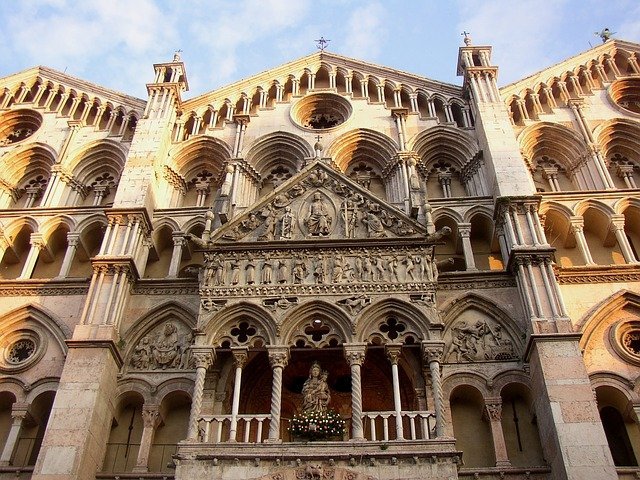
Located in the heart of Ferrara, in front of the town hall and a stone's throw from the Estense Castle, the Cathedral of San Giorgio boasts a marble façade richly decorated with very elaborate sculptures related to biblical stories and the Universal Judgement.
The lower part of the facade is in Romanesque style with all-six arches, while the upper levels are in Gothic style with the typical acute sixth arches. The lions guarding the main entrance are more recent replicas, being the originals kept inside the cathedral, characterized by a baroque style of the early eighteenth century.
On the left side of the cathedral runs a long medieval portico, under which there are shops of souvenirs and artisan shops.
3. Cathedral Museum
Artistic masterpieces that once adorned churches and monuments citizens today are preserved at the Cathedral Museum in Via San Romano 1. Among these, Renaissance works of art such as the forms of Master of the Months, the majestic Madonna della melagrana by Jacopo della Quercia and the monumental organ doors depicting Saint George and the dragon and the Annunciation by Cosmè Tura.
4. Palazzo dei Diamanti – Pinacoteca Nazionale
Ideal center of the so-called "Addition Erculea", the Palazzo dei Diamanti of Corso Ercole I d’Este 21 was one of the city residences of Este and owes its name to the particular decoration of roses on the facade. Ariosto, who enjoyed many privileges within the court, certainly, had the opportunity to visit him several times.
Perhaps, these verses of Furioso, are referred to the palace: «Surgea a palace in means to the plain / that it turned on to be a living flame [...] / that all of a gem is ‘the wall schietto / more than polished charcoal and wakefulness» (XXXIV, 51,53).
From 1866 the Palazzo dei Diamanti houses, on the noble floor, the National Gallery Among his masterpieces, he has a vast collection of works from the 16th century by local artists such as Dosso Dossi, Garofalo, Bastianino.
5. Palazzo Schifanoia
The eastern delight of Schifanoia in Via Scandiana 23 in Ferrara was erected in 1385 by Alberto V d’Este. The austere red brick facade conceals the wonder of Salone dei Mesi from the Renaissance era, frescoed by the most renowned court painters.
An extraordinary work that exercised a great charm also on Ludovico Ariosto that, in the pages of the Furioso Orlando, revives some of the themes represented on the walls of Schifanoia: the fantastic Cavalleresco world, astronomical and astrological themes, the world of the court.
6. Le Mura di Ferrara
The old town is still largely surrounded by several kilometers of walls with a series of fortifications resulting from the aggregation of various defensive apparatuses, built from its foundation to the war against Venice (initiated in 1482). Along the Walls Ferrara, you can walk or ride for 9 km in the green, observing bastions, towers, cannons, doors, passages, defensive structures that helped protect the city, surrounded by trees and meadows. And then continue towards Via delle Erbe, a piece of countryside in the middle of the city.
7. The house of Ariosto
Among the things to see in Ferrara there is certainly the house of Ludovico Ariosto, in Via Ariosto 67, the residence where he spent the last years of life dedicating himself to the third and definitive editorial staff of the Furious Orlando (1532). Here the poet will die on 6 July 1533, at 58 years.
Note, on the facade, the famous inscription «Parva, sed apta mihi, sed nulli obnoxia, sed non sordida, part meo, sed tamen aere domus» (The house is small but suitable for me, clean, not burdened by canons and purchased only with my money).
8. Tomb of the Ariosto at the Ariostea Library
The magnificent funeral monument in polychrome marble crowned by the portrait bust of Ariosto, is located in Staff of the Library in Via delle Scienze 17. The library has many rare and precious manuscripts. A large stone dedicated to him is located on the landing of the staircase of honor.
9. Garden of the Duchess
From this garden, created in 1481 and flanked by two lodges, it reached the castle of Ferrara. Locus amoenus par excellence, the Garden of the Duchess may have inspired the Ariosto – along with the roof garden of the castle – in the description of the imaginary gardens located in the Orlando (garden of Alcina, garden of Logistilla).
10. Ebraic Ferrara
The itinerary can continue in Ferrara Hebrew, born from Via Mazzini between the streets and houses of red terracotta, where you can see the Jewish Museum and the Synagogues, rich in traditional objects and cult, and in the places of testimony of the city that cross with the literary itineraries of the writer Giorgio Bassani, in the real and imaginary search of the Garden of Contini Finzi. In Via Piangipane it is worth stopping at MEIS – National Museum of Italian Judaism and Shoah.
Ferrara Where to eat and drink
Makore
Creative cuisine, authentic and transformation from Makoré, fine dining restaurant where the fish is the absolute protagonist of the table. The chef Denny Lodi Rizzini and Gianluca Greco omate the beautiful season with a light, fresh and delicious menu, a journey through traditional dishes and not only, reinterpreted with creative and fun accents.
Among the appetizers, Sgombro, salicornia and carpione, a tribute to Venice, the city of the heart of the chefs, where they worked several years before arriving in Ferrara.
Among the first stands the Canatella, crab, onion and soup, signature dish, combination of two types of pasta, cannellone and tagliatella. Starting from two typical formats, the chefs have designed a hybrid to give the public a new experience in respect of tradition. As a second, unmissable Cartoon cod, that in fact to the real cartoccio is not, and to close the sweetness Brazadela, signature dish, revisitation of a traditional Ferrarese dessert of 1200 that was prepared on the occasion of the festivities.
In addition to the à la carte menu, Makoré offers two tasting routes, both blind.
The first, "Racconto", is a proposal of 5 courses inspired by local and seasonal cultures, whose leitmotiv is "antispreco" that gives value to raw materials, minimizing the waste. The second, "Viaggio", consists of 8 suggestions, a path based on the experiences lived in Italy and abroad that through research and development are reproposed.
Enoteca "at Brindisi"
Opened in 1435 and known, then, as "Hostaria del Chiucchiolino", the wine shop in Brindisi by Via Adelardi 11 (at the time via del Gorgadello) was attended by many illustrious artists (Welcome Cellini, Tiziano, Torquato Tasso) including the Ariosto who, in his comedy La Lena, reminds her by writing: "The most confarebric cuckoo eyes of Sabbatino Mariano and the like, when of Gorgadel drunks come out".

