

Gondola origins, history and curiosity of the romantic boat symbol of Venice: make a gondola tour for the canals of the Serenissima aboard this elegant boat is a must for every tourist.
Index of Article
Gondola origins, history and curiosity
But what we know about the origins and history of the gondola?
In this article I tell you origins, history, features, but also many curiosities about this emblem of the marine lagoon, on the art of the last Venetian squirrels and on how two historical gondolas became ambassador of Venice in China aboard a cruise ship.
History of Gondola
In Venice, during the peak of the Serenissima, people walked little and moved mostly by boat. As you can see today, all the palaces and noble houses have the main entrance on the water, while the doors on the back, more modest and anonymous, were reserved for service personnel.
This is why every family, regardless of the prestige, had their own gondolas and their gondolas ("gondolieri de casada"), commissioned to transport the masters and their family between the canals and from one palace to another.
Those who could not afford a boat and a gondolier, could choose between tens and tens of stazijs located at every corner of the city, where, at any time of the day, they could climb on a gondola rental and be transported throughout the city, to the islands of the lagoon or to the mainland.
The origin of the gondola name is still unknown. The most reliable version establishes etymology in the Latin term cymbula, indicating a small boat, although other sources claim that the origin is instead the Greek word kountelàs, which means "short boat".
The gondola has no official birth date, but it is in a decree issued by the doge Vitale Falier in 1094 that the term emerged for the first time in the form of "gondolam".
The ancestors of the gondola were slightly shorter and narrow, less arched, with the aft part higher than the bow and few decorations, but above all they were symmetrical. The fork was a simple flat table, completely different from what it is today. Iron was a normal piece of metal sheet molded to protect the boat in case of collisions.
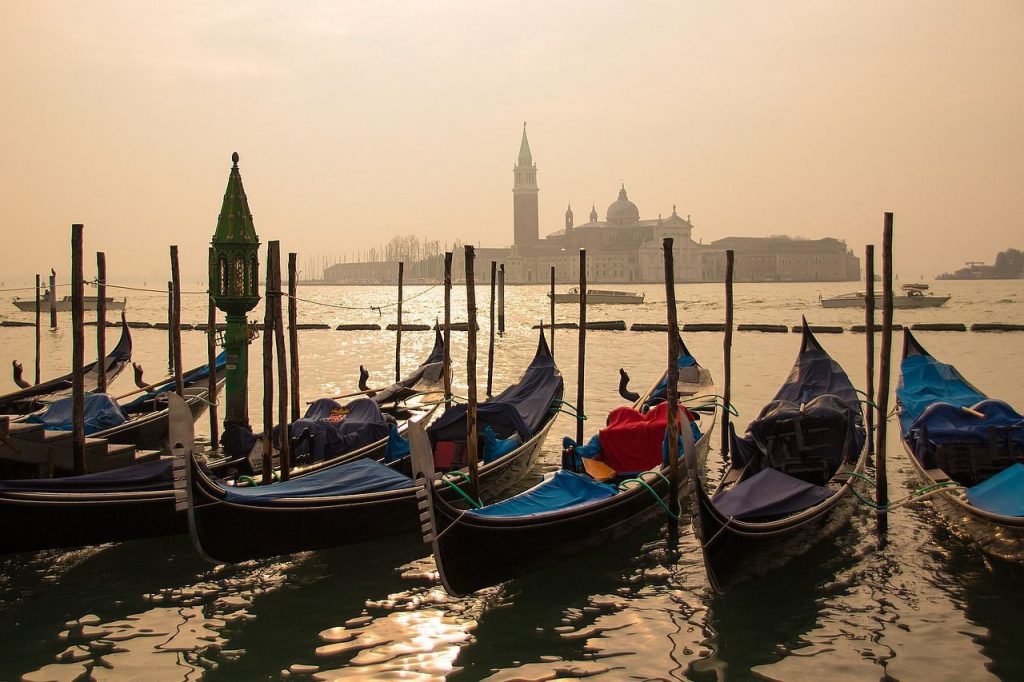
If the technical differences between the gondolas were numerous, the qualitative ones were no less: in 1580 there were about 10,000 gondolas, while today there are only 433.
Try to imagine the show of 5-6,000 drum gondolas ready to welcome some illustrious guests, such as in 1574 when Henry of Valois, son of Catherine de’ Medici was crowned Henry III of France on May 30, or in 1825 when a regatta of a hundred gondolas accompanied the Emperor of Austria Francis I and his consort along the Grand Canal.
One of the reasons why the number of gondolas has collapsed so drastically is traceable to the development of motor boats, which have gradually shaded what has always been the symbol and essence of Venice.
Characteristics of the Venetian Gondola
The Venetian gondola is 11 m long, about 1,65 m tall, 1,42 m wide and weighs about 500 kilos. The most peculiar of the characteristics of the gondola is its asymmetry on the longitudinal axis, from stern to bow, with a deviation of about 24 cm to the right regarding the left. The purpose of this form is to compensate for the shift caused by the Venetian rematura style to a single oar.
The oar, made of beech wood, has the fundamental role of rudder. The fork is the place where the oar is housed, and is made of walnut wood.
Despite its remarkable length, the gondola is extremely handy thanks to its flat bottom and the reduced portion of hull under water, and it is maneuverable also in very tight spaces.
Each gondola consists of 280 pieces of wood, fixed with galvanized nails.
For this reason the construction of a gondola requires a greater variety of wood than other boats, for which are used oak, larch or pine. In addition to these three types of wood, holm, lime, oak, cedar and mahogany are also used for gondolas.
In total, eight types of wood are used, selected not only for the specific characteristics, but also according to the available sizes: the oak wood is used for the hull, especially the sides, thanks to its high resistance; the olm, very hard but also extremely elastic, is ideal for the edges.
The cedar is strong and compact but very malleable, and therefore suitable for the cross-sections decorated and carved; the mahogany, robust and often, is normally used for the stern and bow parts, thanks to its high spongeness that helps prevent the formation of cracks; the pine and larch, very resistant to the water, are used for the parts immersed in water; finally the nutility, thanks to its
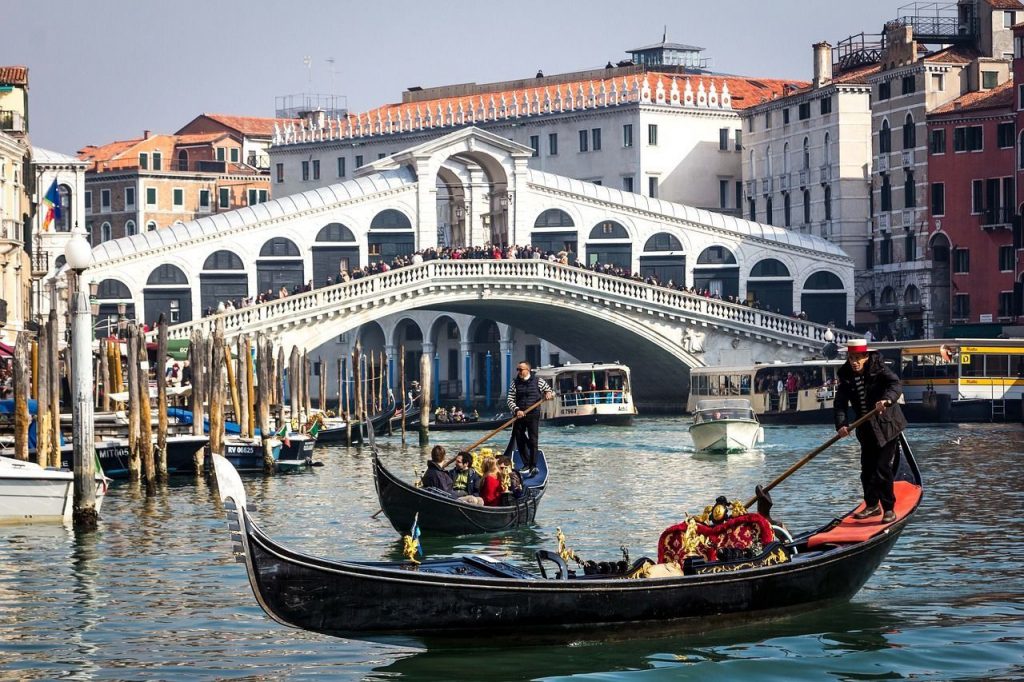
Although the gondolas are combined with different characteristics, each of them is actually a unique piece. Each gondolier has its own personal gondola, and each boat is made to measure for its gondolier: the driving station, the oar and the fork are designed and built in relation to the height and arms of the gondolier that will have to use them.
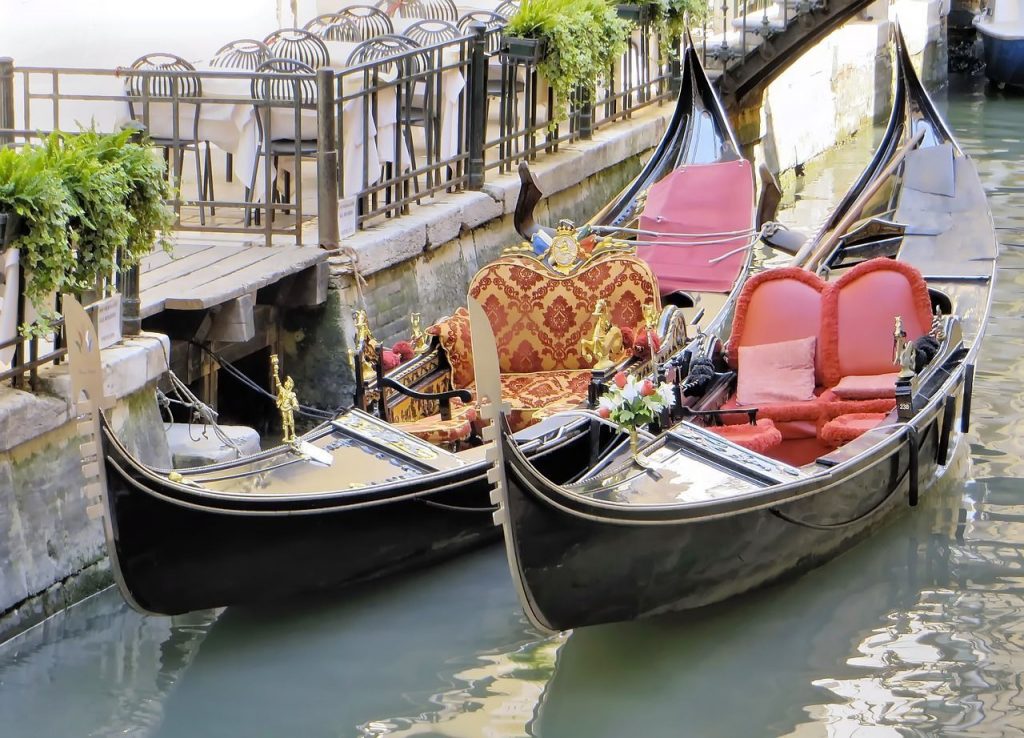
In addition, each gondola is easily recognizable thanks to its decorations and its particular carvings. It is important to remember that the decorations develop symmetrically, but with asymmetrical details.
Once, the outer carving decorations were made on other pieces of wood and not directly on the structural parts. This was probably due to the possibility of using the most suitable wood types.
Today it is no longer so, for both economic and aesthetic reasons, and decorations are practiced directly on the wooden parts of the boat.
How much does a gondola ride cost in Venice?
The official base rates approved by the Municipality for a gondola tour in Venice are 80,00 euros for a 30-minute day tour from 9.00 to 19.00 and 100,00 euros for a 35-minute night tour from 19.00 to 3.00.
Not everyone knows, however, that it is also possible to remove the advantage of a gondola tour in Venice spending only 2 €.
What? Using the Ferries from Parada, that is the public service of gondolas that connect the banks of the Grand Canal. Of course it is not like a romantic tour of the canals, but the experience still has its charm.
Saturday 19.00 a.m. – Saturday 19.00 a.m. – Saturday 19.00 a.m. – Saturday 19.00 a.m
Squeri and Squeraroli
The lagoon shipyard where boats and gondolas are built is called in Veneto squero, while the buildings that host it are called "tesa".
The squerarolo is the artisan who, piece after piece, slowly gives shape to each gondola. In the wake of a secular tradition, each squerarolo builds its own gondolas without the help of projects or drawings. Each gondola is therefore a unique piece, a true object of art, perfectly distinguishable from others.
It does not exist, nor has it ever existed, a standard for the construction of a gondola: each craftsman proceeds according to his own intuition and his ideas, varying dimensions and proportions of the gondolas according to the needs.
Each squerarolo learns the craft through apprenticeship at a master builder until he is able to build his own boats. A unique work, and an art that has become extinct.
The art of squeraroli was one of the most important arts of the Serenissima, the ancient Republic of Venice, since the development and life of the city depended on the water and the means to move on it.
This Art was born in 1607 by the Council of Ten and included two columns, the so-called big squeraroli (in charge of the construction of medium-range boats) and the sotil squeraroli (which built the smaller boats); these craftsmen separated from the shipbuilders in 1607.
Until 1621, the School was in the church of San Bonaventura, in San Marcuola, so it was moved to another part of the city, in the church of San Trovaso.
Today the art of building gondole is at a particularly crucial point, almost paradoxical: the question exceeded the offer. The crisis in the sector is no longer due to the lack of wood, but of skilled labour.
Experienced shipbuilders now count on the fingers of a hand, while the younger ones, in a city increasingly devoted to the service sector, choose easier and less demanding professions.
The Squero di San Trovaso
The squero di San Trovaso is one of the oldest and most famous shipyards in Venice. It is located along the homonymous canal and dates back to 1600. It is one of the few still active sharks in Venice.
Unusually for Venice, the buildings surrounding the squero recall the architectural style of the houses of Cadore in the nearby Dolomites, from where the first naval carpenters and most of the wood used for the construction of boats arrived in 1600.
Today at the squero di San Trovaso the gondolas are built and restored using the same sophisticated techniques handed down from generation to generation.
Considering that the average life span of a gondola is about 40 years, most of the work done by shipyards concerns the maintenance of the outside of the boats; this is why the yards are facing the sun: to allow the correct drying of the gondolas.
The construction of a gondola takes about two months, and they are usually produced only one or two a year also because the builders must respect a very precise sequence of activities that includes different interruptions, such as moving and turning the boats, or the involvement of other craftsmen such as carers, blacksmiths, etc.
Today, these yards try to reserve a covered space, sheltered from dust, for delicate painting interventions, which require a much higher degree of attention than the past, when the tar was used.
The squero di San Trovaso also produces original accessories for gondolas such as forks (typical Venetian scales), cemeteries (ornaments), flag decorations, stern rings, ornamental horses in different sizes; moreover, it also sells paintings made on wooden plates coming from abandoned gondolas, custom items with carvings and decorations on request, second-hand gondolas for free time or exhibitions.
Two historic gondolas aboard Costa Venezia
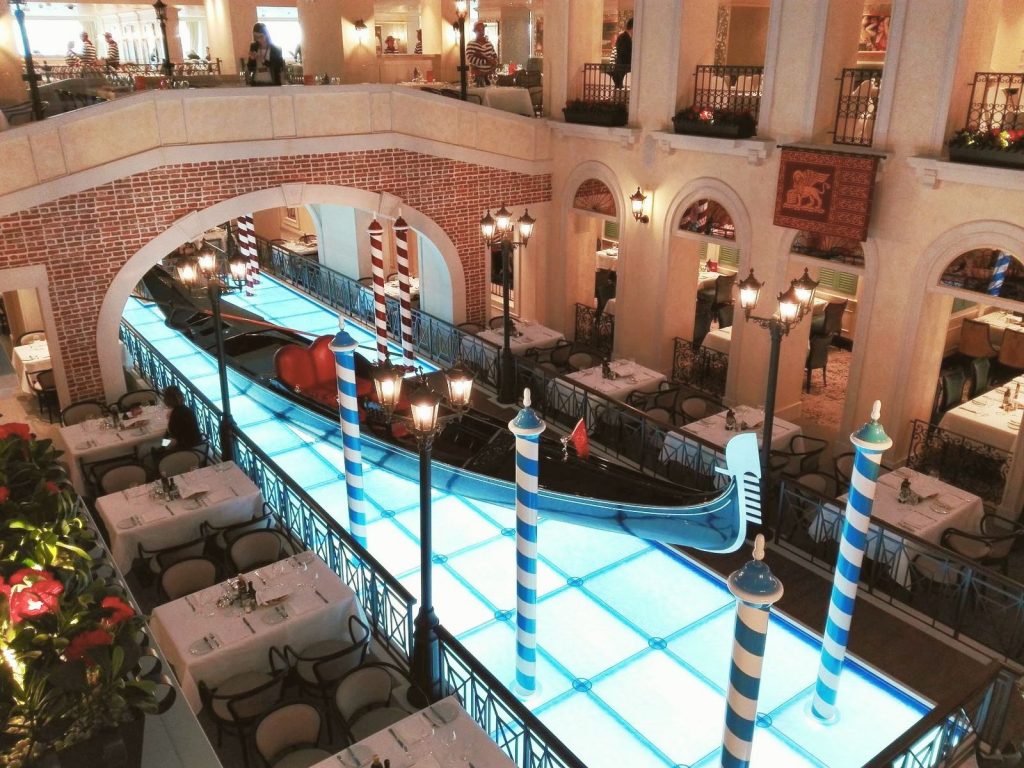
The two historical gondolas are also coming from the squero di San Trovaso, which were placed on board Costa Venezia, the theme ship Serenissima launched a few months ago and destined exclusively to the Chinese market. Two families of gondolas belonged to the Grand Canal Restaurant on deck 3 and in the Gondola Lounge on deck 5, becoming embassies of secular art of the Serenissima.
The gondola of the Russian Family
The first is the gondola of the Russian Family, which tells us the story Lorenzo Russo: "In 1983 Gianni Russo, gondoliere since 1970 for the ferry service of the Church of San Beneto a Venice, commissioned to the squero of San Trovaso the construction of a gondola.
The carpenter Gastone Nardo, great friend of Gianni and custodian of secrets and centuries-old traditions, built the gondola to perfection, producing his yet another masterpiece: a perfect gondola and curated to the smallest detail.
The gondola was pumped up a few months later, with rivers of good wine and great food for all guests at the inauguration. The same afternoon of the varo, the new gondola, subtle and refined, fast and easy to manoeuvre, began a long career, navigating day and night between the Venetian canals.
Its seats have welcomed Chinese and Indian, German and Turkish, American and French, Arab and Swedish tourists... If this gondola could speak it would be an incredible polyglot!
Gianni Russo worked between the canals of Venice until retirement, after which the gondola passed to his son Lorenzo, already introduced since childhood to all the secrets of this splendid profession. After a few years of apprenticeship, Lorenzo took full possession of the gondola and in 1992 he began working with the "Traghetto del sal" (point of customs).
In 2001 the gondola of the Russian family was completely renewed with a new hull and new parts by the new owner of the squero of San Trovaso, Lorenzo Della Toffola, heir of the mastery of Gastone. The new gondola, in full respect of the canons of the naval tradition, has consolidated the close and lasting relationship between the Russians and the squirrel of San Trovaso.
Over the years, the gondola was used for religious events, filming (Indiana Jones and the last crusade) and weddings, and remained in use until 2018. Today the ship builder Lorenzo Della Toffola of the squero of San Trovaso has a new gondola ready for the Russian family and after 35 years of honored service, our beloved old boat is ready to withdraw from the scenes. "
The gondola of the Santini family
The other gondola belonged to the Santini family, as Alessandro Santini recalls, called "Bagoina". "In 1987 my father, Sergio Santini, known as "Bagoina", commissioned the construction of this gondola to the squero of San Trovaso. The choice falls on Gastone Nardo, a great family friend and an extraordinary gondola builder.
My father had already used in the past the gondola of my grandfather, Pietro Santini, known as "Bagoina", who worked as a gondolier at Rialto-Carbon station since the 1930s.
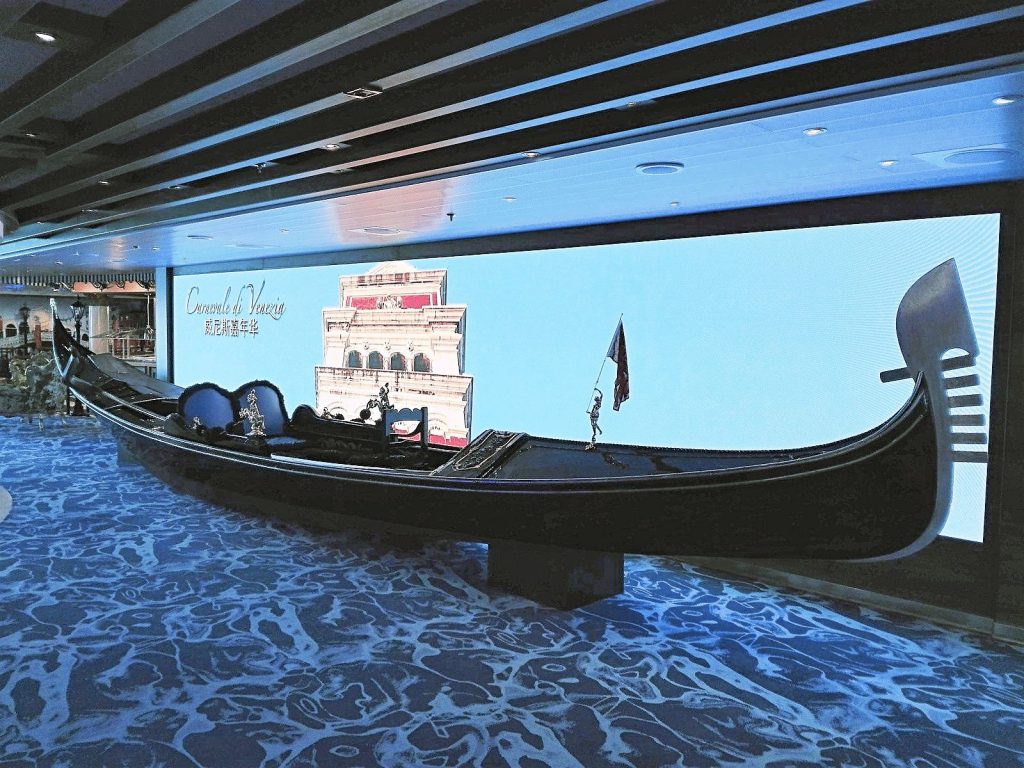
The day the gondola was launched, I was fourteen. I was the first to sail on this gondola, which over the years helped me consolidate my gondolier skills. My father used it until 1995, when I received my license and inherited the gondola. I have always loved and cared for with great passion: it has always been much more than just a gondola for me.
This gondola has participated in many weddings, advertising, movies, music videos, and thousands of people from all over the world have had the chance to enjoy the view of Venice that only a gondola can offer.
In 2018 it was up to me to commission a new gondola, of course always from the same yard of the master Lorenzo Della Toffola, great friend, extraordinary builder of gondolas and precious guardian of this unique art in the world.
However, even if my old gondola has reached retirement, no one forgets the first love and I will never forget my faithful companion on the Venetian waters.
I remember those delicious summer serenades and those shady autumn days, when we all would have preferred to stay at home, but we had to work and stay on our gondolas, always together, in a magical Venice ammantata by the fog. "


Questo sito è molto interessante e ha fatto scoprire nuove cose a me e hai miei amici.Molto affidabile e carino!