
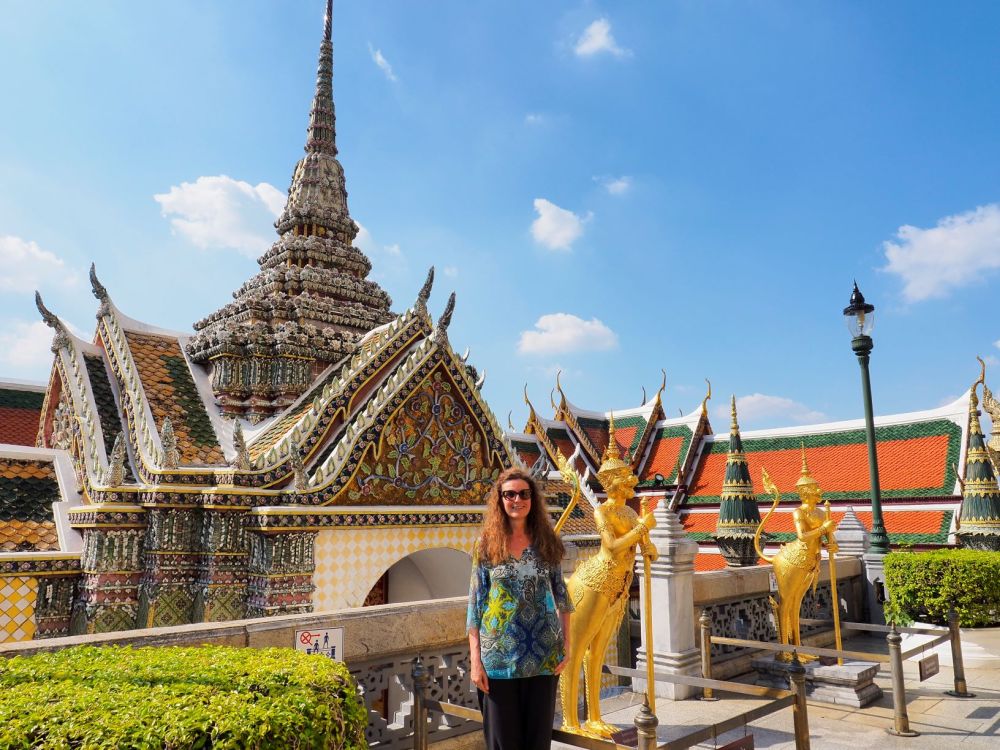
Grand Palace Bangkok, complete guide to the visit of the Royal Palace, the main attraction of the Thai capital.
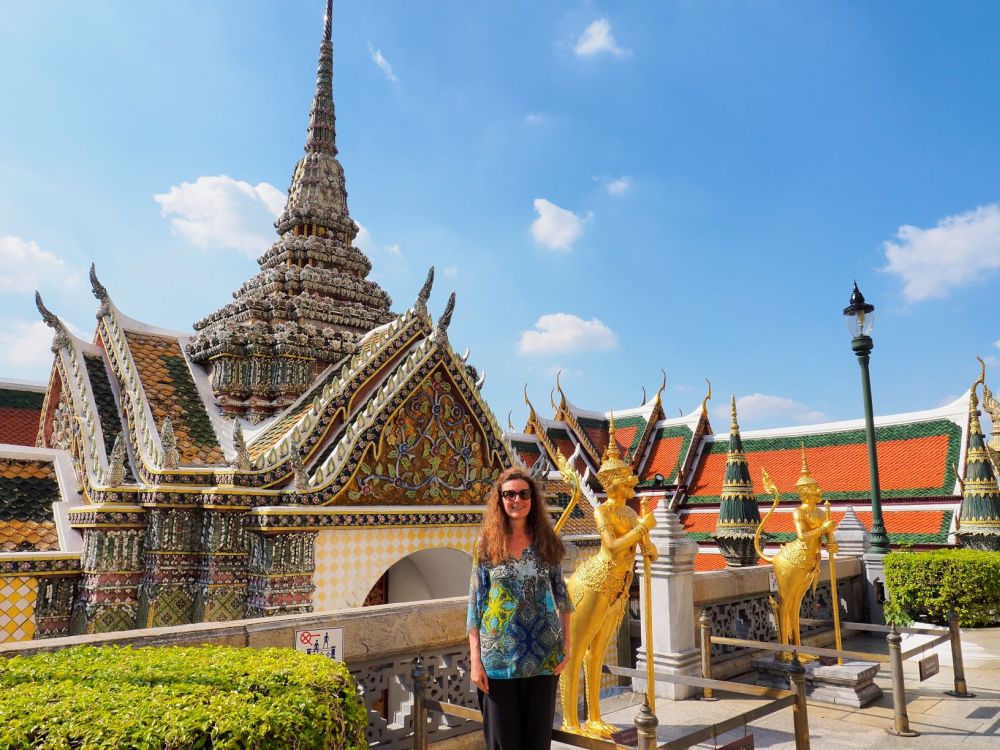
The Grand Palace is the most visited attraction of Bangkok and if you are planning to visit the Thai capital, it can only be the first stage of your itinerary. I personally visited it at least four times and every time I pass to Bangkok I come back with pleasure, letting myself be enchanted by the magnificence of its gorgeous buildings. Based on my experience, in this complete guide I summarized everything you need to know about Grand Palace Bangkok, including some tips useful to plan your visit best.
History of the Grand Palace
The history of the Grand Palace goes hand in hand with that of the kingdom of Thailand. Once the official residence of the Kings of Thailand, still today Grand Palace Bangkok It is used by the King on the occasion of rituals, funerals, weddings and royal banquets. Surrounded by high walls built in 1783, in addition to Wat Phra Kaew Temple of the Emerald BuddhaInside, there are government offices, monuments, royal residences with different architectural styles, reflecting the times in which they were built, scattered between gardens, meadows and courtyards on an area of 218,400 square meters.
When Rama I assumed control of the country after the fall of Ayutthaya moved the center of the government to the island of Rattanakosin on which the Grand Palace was erected within a fortification.
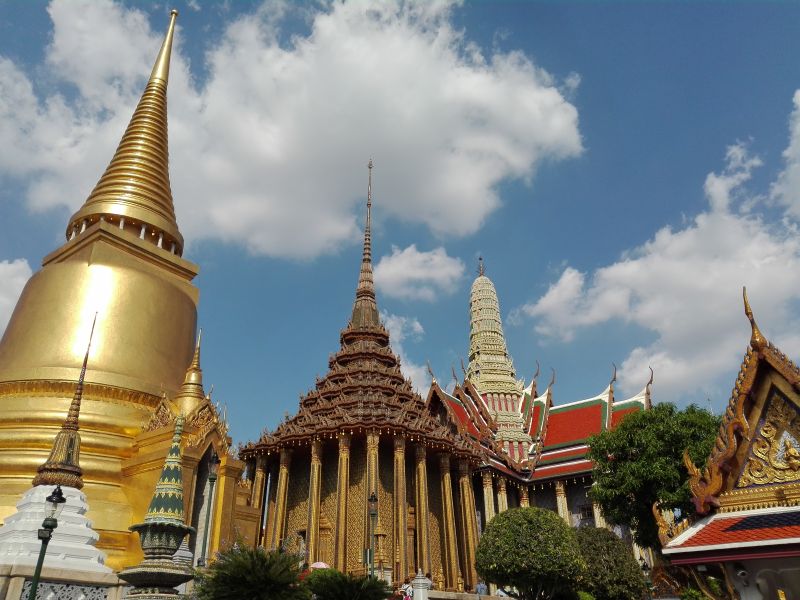
At first it was just a series of simple wooden structures, later gradually replaced by brick buildings from royal palace of Ayutthaya destroyed during the war with Burma in the mid-18th century. The structure of the Grand Palace Bangkok resumes that of the building complex of Ayutthaya and includes an outside courtyard where the former government and other public buildings are located, the Wat Phra Kaew Temple of the Emerald Buddha, a central court with the king's residence, buildings used for occasions of state and an inner court that housed the queen, the consorts and daughters of the king.
The complex includes some of the most sumptuous buildings in the country, enriched with hand painted ceramic decorations, carved wood, ornamental tiles and a large profusion of gold everywhere. Over the centuries the various monarchs have added new buildings that show Chinese and European influences, creating curious exotic hybrids. For example, the royal residence and some administrative buildings have a neoclassical style, decidedly European, but with the Thai-style roof.
The court and government offices were located in the Grand Palace Bangkok complex from 1782 to 1925, when the royal family moved to Palazzo Chitralada, Dusit district.
Visit of Grand Palace Bangkok
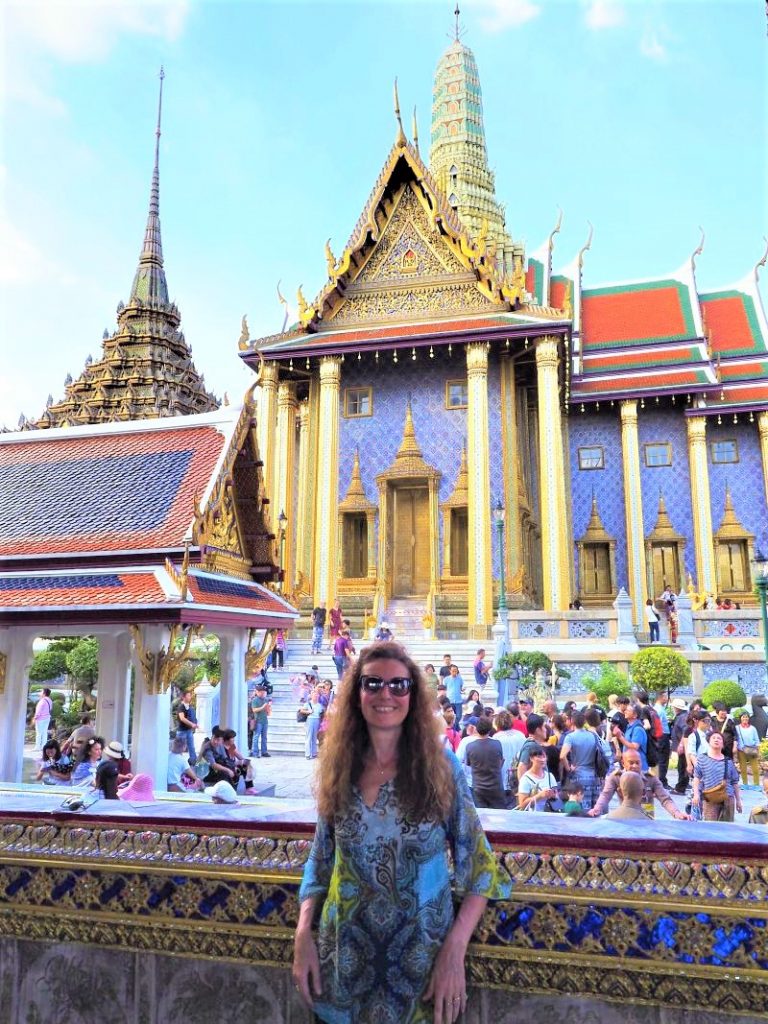
The tour starts from the Central Court, the largest and most important of the Grand Palace Bangkok . As the name suggests, this court is located in the central part of the palace and houses many important residential and state buildings. The court is divided into three groups, namely the Phra Si Rattana Chedi, the Grand Palace Chakri Mahaprasad Hall by the colorful roofs on pagoda and a large amount of colorful statues, and a part called the garden district of Siwalai.
The two oldest buildings are Dusit Maha Prasat Throne Hall and Phra Maha Monthian. The main function of the throne room Dusit Maha Prasat, built by King Rama I, is to accommodate the burning chamber of kings, queens and members of the deceased royal family, so that the greater number of people can pay homage to the deceased.
One of the most recent buildings is the Borom Phiman Mansion, built in the early 20th century by King Rama V in Western style as a residence for future kings.
The Throne Room
The neoclassical dome of the Throne Room looks like an anomaly
in tropical Bangkok. Made of dazzling Carrara marble, the building would certainly be more suitable to be inserted in the context of Paris or Pisa. You would never imagine it, but the Throne Room Ananta Samakhom is the fruit of the Italian genius.
Its construction was commissioned by King Rama V who wanted a reception room for court guests and commissioned the work to Italian architects Annibale Rigotti and Mario Tamagno (who also designed the Hua Lampong station in Bangkok and the Oriental Hotel).
The building, which resembles a wonderful wedding cake, shines under the bright Asian sun, and from close to you can see its elegant details: faces and carvings all created by the sculptor Vittorio Novi.
The exterior elegance continues inside. After entering from a staircase, you are in a small but sumptuous octagonal room, where the panels of the walls are decorated with a sparkly collage of choleop wings that must have taken to the artisans hundreds of hours of work.
This attention to detail continues in the main hall with carpets, royal signs and shrewd Corinthian columns that compete with the majesty of European palaces. But when they raise their eyes to the sky, they are the Thai style decorations to capture attention; paintings that tell the story of the Chakri dynasty from the reign of Rama I in Rama VI.
As in every treasure chest that is respected, the outer beauty of the Throne Room is overcome by the objects displayed inside. His Majesty King Bhumibol Adulyadej has long supported the creative talent of the Thai people and promoted the rich cultural heritage of the Kingdom. He established a Foundation in 1976 to preserve and develop the traditional arts and crafts of Thailand.
The most fascinating piece in this space is the carved teak screen created on the occasion of the celebrations for the 60th anniversary of the King's accession. This work of art shows scenes from the legend of Sang Thong, which concerns the story of a deformed and good hero who wins the heart of a high lineage heroine. Other large works are the incredible decorated tapestries. They look like sparkling paintings, in fact, close by, reveal intricate details of silk threads.
The Siwalai Garden
The Siwalai Garden, also called "Garden of Crystal", "Giardino Giusto" and "Giardino delle Tartarughe" in ancient times, is located on the eastern side of the middle court. In the course of its existence the garden was modified by the various kings and acquired its present form during the period of King Rama V, contains both royal residences and religious buildings.
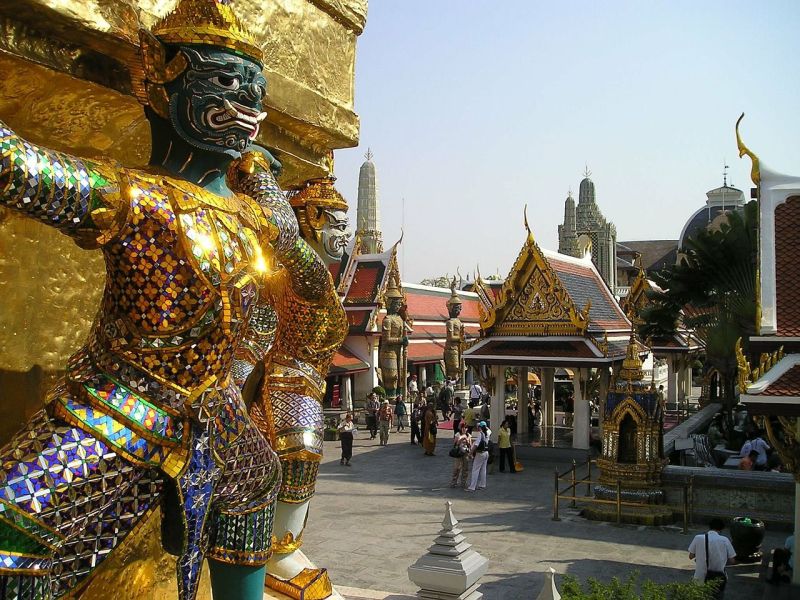
During the visit you can see great gold monuments such as the Phra Si Rattana Chedi, the colorful roofs on the pagoda of the Grand Palace Chakri Mahaprasad Hall and a great deal of colorful statues.
The Corte Esterna is another important part of Grand Palace Bangkok, located in the north-west of the site. The court area consists of many buildings, the most important of which is the headquarters and information center of the Gran Palace, the royal family office and the office of the chief secretary of His Majesty. Other buildings include the Sahathai Samakhom Room, used for important receptions and meetings and the Luk Khun Nai Hall which houses various departments of the Royal House, and the Pavilion of Regalia Museum, Royal Decorations and Coins.
Wat Phra Kaew
The most significant building within the Grand Palace complex is the Wat Phra Kaew, the Temple of the Emerald Buddha, the most sacred place of worship in Thailand. Here we venerate the Emerald Buddha, a small statue of the Green Jade Buddha about 75 cm tall considered a talisman for Thailand and its people.
At the end of the 18th century, the temple is a masterpiece of traditional Thai architecture.
King Rama I was the initiator of the construction of the Temple of the Emerald Buddha when he moved the capital from Thonburi to Bangkok in 1785. The story tells that the statue traveled from India to Cambodia, to Laos to finally arrive in Thailand. Two mythical giants called "yakshis" mount the guard to the main ordering room, or "ubosot", which houses the Emerald Buddhadecorated with frescoes depicting the stories depicting the different previous lives of the Buddha, the most interesting of which overlooks the altar depicting the victory of the Buddha on the "Mara", the evil demon.
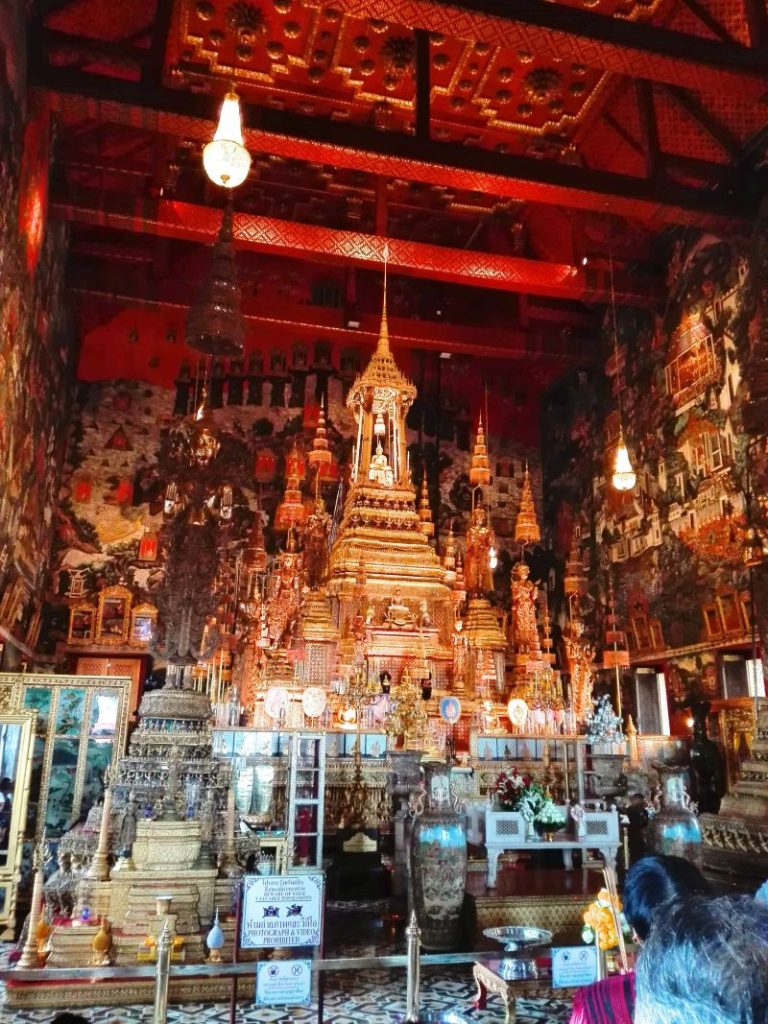
The statuette, which reproduces the Buddha in the pose of meditation known as Virasana, is placed on a high stage consisting of several platforms that prevent visitors from reaching the statuette, except the King of Thailand. Only the King is authorized to perform the rite of the change of the coats that cover the statue, which takes place three times a year in correspondence of the three seasons: summer, winter and rainy season. It is believed that this ritual brings luck in the country on these seasons dates.
Very charming is also the open colonnade surrounding the temple, decorated with frescoes depicting Ramakian, the Thai adaptation of Ramayana, the famous epic in India, Pakistan and Sri Lanka. There are over 170 scenes, painted during the reign of King Mongkut (1825 – 1859), but several times restored.
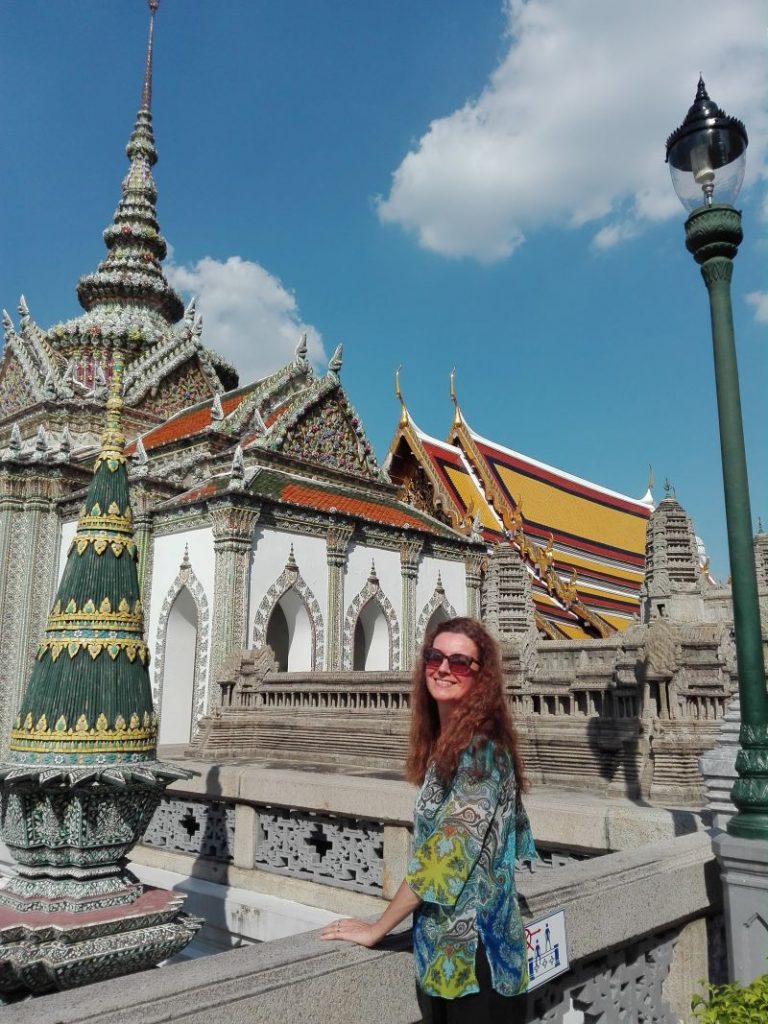
Other attractions of the complex include a variety of fascinating statues, pagodas and religious structures: a model of Angkor Wat of Cambodia built during the time when the Thai territory included Cambodia, the golden Phra Si Rattana Chedi which houses the ashes of the Buddha, two libraries that house important Buddhist documents and literature and the Pantheon with statues of natural dimensions of the first seven kings of Thailand.
Grand Palace How To Get
River taxi
You can easily get to Grand Palace Bangkok with river taxis, an economical solution, which allows you to avoid traffic and enjoy the Chao Phraya landscape along the way.
With Skytrain BTS, arrives at Saphan Taksin station, then follow the signs for the boat dock. Take the river taxi for nine stops to the Tha Chang pier.
If you lose the support account, don't worry. Grand Palace Bangkok extends between Tha Thien's pier and Tha Chang's pier and it will be impossible not to see it from the boat. Once down to the pier of Tha Chang, walk the short distance to the entrance of the palace.
Walking
From the area of Khao San Road you can walk in about 20-25 minutes to the Grand Palace, following the edge of the real field or along the road closest to the river.
Grand Palace opening hours
The Grand Palace is open seven days a week from 8.30 to 16.30, but the ticket office closes at 15.30! So you have to get there first.
Occasionally, Grand Palace Bangkok closes for official visits and state functions, but is a rather rare possibility.
Grand Palace entrance tickets
The entrance ticket to Grand Palace Bangkok is 500 baht (about 18 Euros), but for Thai citizens it is free. You can rent an audio guide for another 200 baht. Of course there are also tourist guides, but you will need to negotiate the fare of the visit with them. In this regard I recommend you choose an official guide within the complex, rather than accept the offer of an improvised guide outside.
Grand Palace Dress Code
To visit the Grand Palace Bangkok you must stick to a precise dress code. As a sign of respect, you should not wear shorts or sleeveless shirts in any temple or state building in Thailand, especially at Grand Palace Bangkok, where the dress code is strictly applied.
The basic rule is that men have to wear long pants and women have to cover their legs just above the knee.
– Avoid wearing tight stretch pants or transparent garments,
– Do not wear sleeveless shirts or leave your shoulders uncovered,
– Do not wear t-shirts with religious themes or death symbols, such as heavy metal shirts.
– Even flipped sandals would not be allowed, but this rule is usually overlooked for tourists. In any case, shoes must always be removed when entering temples and sacred places.
If your clothing is not appropriate, you will be required to cover with a pareo. Assuming that the stand is open and still will be available, you can borrow one for free (with a 200 baht refundable deposit). Otherwise, just cross the street in front of the entrance to find a myriad of T-shirt sellers, parei and trousers.

