

Le Havre city of Normandy cradle of Impressionism, UNESCO heritage for modern architecture and the exceptional natural site of the Etretat cliffs.
Located on the Seine estuary, city of Normandy by Le Havre is famous for its port that makes it the marine outlet of the French capital. Connected by railway in Paris, for over half a century was the transatlantic port for passengers departing for the New World, but also a lively seaside resort in which the nautical activities develop, while its light and its special atmospheres inspired the great masters of theFrench Impression.
Here's what to see in Le Havre, the places not to be missed in an itinerary from the city centre to the spectacular Etretat cliffs.
Index of Article
The Havres what to see
Mostly destroyed by the bombings of September 1944, Le Havre was completely rebuilt between 1945 and 1964 by the so-called Atelier Perret: a group of a hundred architects, led by Auguste Perret, who built an impressive architectural complex extending over 133 hectares, symbol of the rebirth of the country, whose value was recognized by UNESCO in 2005 with the inscription on the list of sites World Heritage.
To have an overview of what has been defined "city of architects", it is advisable to climb the 17th floor of the tower of the Hotel de Ville, from which you can enjoy an exceptional view over the city of Normandy. If you want to go down more in detail, you can visit the Appartement Temoin (a witness apartment), a real showcase of the lifestyle and creators of the 1950s, and the Maison du Patrimoine Atelier Perret.
In more recent times, even great international arches-stars have left their unmistakable sign to The Havre. Bring the signature of Oscar Niemeyer le Volcan: cultural space with theatre, national stage and library among the most original of France, whose sinuosity of architectural curves dialogues with the orthogonality of Perret.
They are instead the work of Jean Nouvel i Bains des Docks, an aquatic complex consisting of a dozen basins inspired by the Roman baths in the heart of the southern districts, symbol of the urban requalification of the harbour area more in line with the colossal marine traffic.
Cathedral of Notre-Dame
The Cathedral of Notre-Dame, which combines Gothic style, Renaissance and Baroque, is the oldest building in the rebuilt city centre of Le Havre. Its construction began in 1575 to end in 1638. Over the centuries he suffered from the wars of religion, the Revolution and then, in 1944, the devastation of allied bombings. However, it was decided to preserve and restore it.
Graville Abbey
The Graville Abbey, built in the 6th century, became a place of pilgrimage when it hosted the relics of St. Onorino fleeing the Norman invasions (IX century).
Guillaume Malet de Graville, who returned victorious at the Battle of Hastings, gave her all her glory in the 11th century.
The church has all the characteristics of Norman Romanesque art except for the choir, which was rebuilt in Gothic times. The buildings are surrounded by beautiful terraced gardens, designed «French» ideal for relaxation and meditation, offering an exceptional panoramic view of the city, the port of Le Havre and the Seine estuary.
Le Muséum
The building of the ancient Justice Palace built in 1760 was converted into Muséum in the second half of the 19th century. The temporary, luminous and interactive exhibitions hosted in this place of discovery and sharing for families illustrate the riches of the animal, vegetable and mineral world.
Hôtel Dubocage de Bléville Museum
The museum of the Hôtel Dubocage de Bléville, located in the heart of district of Saint François, was created in the 16th century by the Italian architect Girolamo Bellarmato at the request of Francesco I. It was owned by the navigator Michel Joseph Dubocage de Bléville (1676-1727). It was on his return from a long journey of work in the Pacific Ocean via Cape Horn that bought the villa that now bears his name.
After having modified and expanded it, together with the son has set up a large house of maritime trade and a laboratory of curiosity. The visit of this residence allows us to understand the history of Le Havre and its urban and human development.
Mu
It is a morning of 1872 when Currency paints on canvas his extraordinary perception of a foggy dawn on the port of Le Havre. That painting, "Impression, levars of the sun", is the first work of modern art, inspired by the exceptional light of the estuary. The Havres, its port, its beach, its regattas, later inspired the great masters of Impressionism: Pissarro, Sisley, Boudin, Monet, Jongkind.
The Mu, located near the place where Monet had placed his stand, houses the main Impressionist collection in France (more than 450 works), after the Orsay Museum in Paris.
Several panels mark a path on the footsteps of impressionists and Fauves (Dufy, Marquet, Friesz), from the commercial basin to the entrance of the port and then along the boulevard Clemenceau and Albert 1er before reaching Sainte-Adresse, at the foot of the Cap de la Hève.
House of the Administrator
In front of the fishing port and the ferry terminal, the House of the Administrator is one of the last testimonies of Le Havre in the eighteenth century. Built on five levels around an amazing skylight, it is neither a museum nor a private home. His visit allows us to discover the way of life and the activity of a merchant of the time in the city of Normandy.
Suspended gardens
Since 2008 classified as «valuable garden», they're part of landscape of Le Havre as an emblematic place that offers visitors a world of plant and sensory discovery.
This exceptional site of 17 hectares overlooks the city and offers a wonderful view of the sea, the port and the city.
Original example of conversion, this ancient military fort Built in the mid-19th century it became a large garden dedicated to plant travel through the oceans. The bastions, arranged in thematic gardens, evoke North America, East Asia, the lands of the south and the plants (re)discovered. On the side of the courtyard, sheltered from high bastions, 5,000 m2 of greenhouses house the collections of plants of the city.
Garden of Silence
More intimate but still surprising and interesting, the Garden of Silence is a place of meditation, recollection, reflection, contemplation of what can be the beauty of nature and life away from the hustle and bustle of the port and the city.
The visitor, whatever his beliefs, is welcome. Here he finds a moment of calm and inner peace. After moments of tranquility, why not stop in the shop to buy the jams made by the nuns... a sin of greed that will be forgiven you!
Rouelles Park
For lovers of open space, race, cycling, i 160 hectares of meadows, ponds and woods of the park of Rouelles, offer an exceptional setting for the manor house of Bouteillerie and its 17th century dove, representative of the architecture of the Pays de Caux. At any time you can visit the complete exhibition on the fauna and flora of the park, the perennial botanical garden and the arboretum with 259 different botanical varieties. 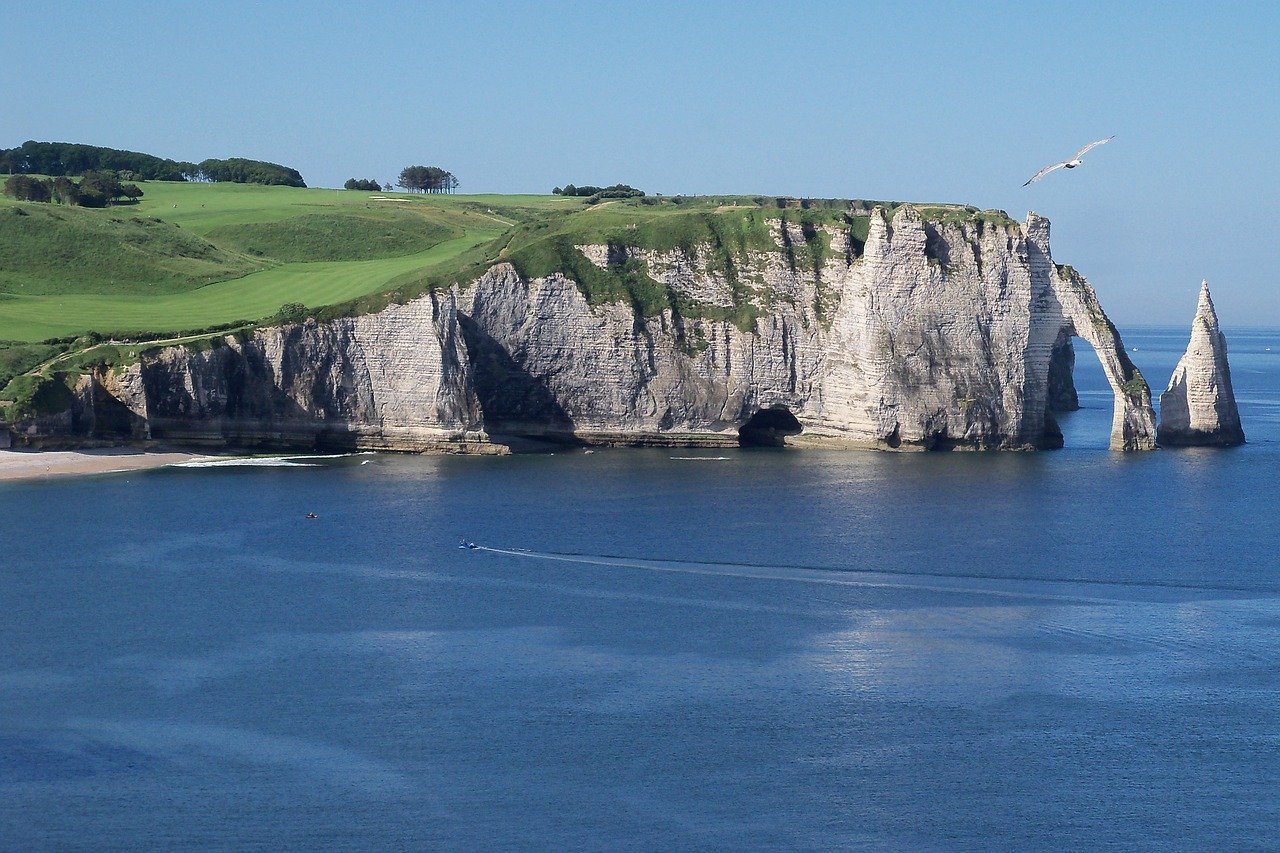
Etreta
The wild charm of coast of Etretat, with cliffs overlooking the sea that form suggestive natural arches, haunted over the centuries the hosts of artists and painters, including Courbet, Boudin, Monet, Valloton, Matisse and many more. Between the Second Empire and the end of the 19th century, it became the preferred destination of many French personalities, such as Jérôme Bonaparte, JulesMichelet, Félix Faure and composer Jacques Offenbach, who built seaside villas.
Writers of the time contribute extensively to consolidating the reputation of the city. The proximity of Le Havre, but also of Rouen and the creation of a railway line allowed Etretat to be known, attended since the end of the 19th century by the Parisian Gotha and the international aristocracy.
Accessible on foot, upstream crag presents at its summit a chapel, Notre-Dame de la Garde, dedicated to the Holy Virgin and tribute to the sailors, but also a fascinating heritage museum that offers a walk in History of Etretat and finally a monument in honor of the aviators Charles Nungesser et François Coli started to attempt, under the command of their plane, the Oiseau blanc, the crossing of the Atlantic from Europe to the United States.
Do not leave this place without visiting Etretat Gardens, a very magical place. The Russian landscape architect Alexandre Grivko planted 10,000 trees and shrubs, massive, rates, rhododendrons, orchids from nurseries in Germany and Belgium and led them to dialogue with the works of contemporary sculptors.
In front, the valley cragHe has nothing to envy his neighbor. His strengths are called the needle, immortalized by Maurice Leblanc and the adventures of his hero Arsène Lupin or even golf one of the most beautiful and original of France. At his feet, we can see the remains of oyster farms and Trou à l’homme. Framed by its two white chalk walls, the beach with its famous pebbles is a popular place for surf and paddle lovers.
The architectural heritage of this delightful Normandy city is rich in many villas including the Clos Lupin (Maurice Leblanc), Guillette 7(Maupassant), lobbyes, Aygues Castle, seaside resort built in 1866, under the Second Empire, and the church of Notre Dame, perfect synthesis between Romanesque and Gothic.
Sainte-Adresse
He was praised by Alphonse Karr, then editor of Le Figaro in the 19th century and then by Georges Dufayel, father of the«Nice of Le Havre» in 1900, Sainte-Adresse embodies the spirit of the sea.
Original and unexpected administrative capital of Belgium, during the First World War, a source of inspiration for the Impressionists, a place renowned for sports, Sainte-Adresse combines elegance and happiness, history, culture and water sports, but also architecture with its many villas.
With a view of the estuary, its picturesque chapel Notre Dame des Flots and its amazing «Pain de sucre», places dedicated to sailors, deserve a visit.
Montivilliers
Montivilliers, obligatory stop on the road of Norman abbeys, is one of the most beautiful and prestigious abbeys of Normandy. Created since 684 by SaintPhilibert, it was destroyed by the Vikings. Reconstructed in the 11th century, it becomes a feminine abbey and the city develops around it. At the time the trade was prosperous (conciation of skins, weaving and fairs). The buildings, now restored, focus on tourism and cultural activities.
They are organized around the cloister: the house of the abbess has become a library, the refectory «Gothic», a space for temporary exhibitions. The scenic audioguided route: "Abbeys Heart" allows everyone to discover the turbulent fate of the «city of the abbess» in medieval Normandy.
The visit would be incomplete without a stop in the fine abbey church of Saint-Sauveur, in which they live the Romanesque and Gothic style. This immersion in the past continues with the Aître de Brisgaret, the Protestant temple, and a pedestrian circuit to discover the local heritage: rooms, Hôtel-Dieu, grating houses, mills.
Harfleur
This medieval past is shared by Harfleur, a once fortified city. Crossing the Lézarde River, the city offers a rich heritage of houses from the 14th to the 17th century, including the Museum of Priory (former inn) and the Town Hall (castle).
The Gothic church of Saint-Martin, considered the lighthouse of the Pays de Caux for its spire, is the masterpiece of this complex and stands out for the interesting contemporary windows of Bernard Piffaretti. The harbour activity of the city known as the «104» ended with the intervention and creation of Le Havre by Francesco I.
Gonfreville the Orcher
Finally, here is Gonfreville the Orcher, whose fortified castle, built on the cliff in the 12th century, dominates the valley of the Seine, thus dominating the port of Harfleur.
Its park offers breathtaking views of the estuary. Every year, the second weekend of October, the event takes place «Plants at the party».
Since 8 May 2019, the Maison du Patrimoine et des Cités Provisoires has opened its doors to the public. This Museum «Cigarette Camps», true space of memory, occupies two restored barracks, collecting objects, furniture, documents, testimonies of a period of history.
The scenography gives new life to the G.I. and then the civilians who lived in Philip Morris' camp. The American army awaiting the return to the country follows the local population affected by the destruction caused by bombing.

