
Discover Lecce what to see and do in the pearl of the Baroque in Puglia, the complete guide of historic center of Lecce and the best experiences to live in the city.
Index of Article
Lecce what to see and do in the pearl of baroque in Puglia
The Salento in recent years has become a very ambite destination, especially during summer holidays. However, in addition to the wonderful seaside resorts that offer breathtaking landscapes, those arriving in this delightful corner of Italy, can not help See Lecce, the pearl of baroque, also known as the South Florence.
Lost in the alleys of historic center of Lecce It is a wonderful experience for all senses because the view is taken from the colors, the palaces, the churches and the monuments that populate it, while the smell is softened by the smells of good typical cuisine.
Moreover, it is a city to measure man, not chaotic and easily visitable on foot, in comfort, following this itinerary that I have prepared for you to discover Lecce What to see and the best experiences to live in the city.
Port of Naples
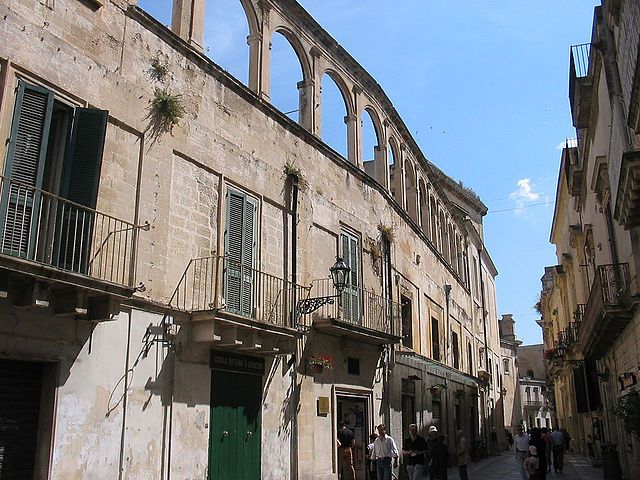
Let's go in historic center of Lecce from the Arc de triumph, erected in 1548 in honor of Charles V and commonly called Port of Naples, which together with Porta Rudiae and Porta San Biagio, is one of the three doors remaining in the ancient defensive city.
As you can see, it is a beautiful monumental portal in Baroque style white stone of Lecce. In reality it is not the original, but it replaced a more ancient door, Porta S. Giusto, which according to tradition lay over the tomb of the homonymous saint.
Piazza Sant’Oronzo
Walking through the streets historical centre we arrive in the beautiful Piazza Sant’Oronzo, the main square of Lecce which marks the end of the Via Appia, the Roman road towards southern Italy. At the centre stands the statue of the holy protector of the city, erected in 1666 after the population had defeated the plague, which broke out ten years earlier.
In addition to the statue of Sant’Oronzo you can admire other structures worthy of note as the church Santa Maria delle Grazie, lRoman amphitheatre of Lecce and the splendid Palazzo del Sedile, on the right side of the square, so called for its particular form. It is a loggia built in 1592, recently renovated, which in recent centuries was also the seat of the Court.
Roman amphitheatre of Lecce
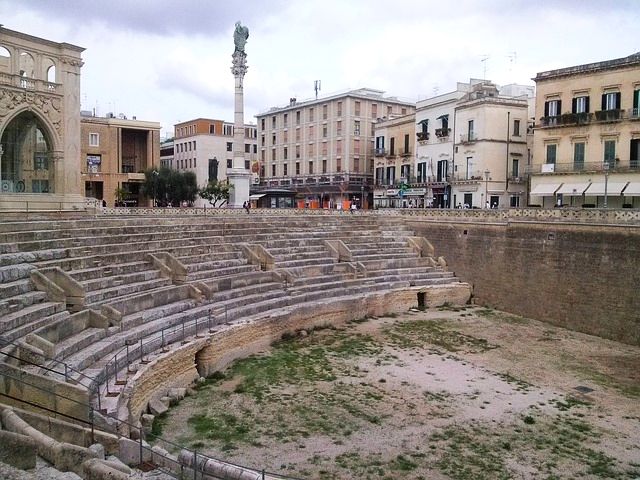
On the south side of the square opens majesticRoman amphitheatre of Lecce of the second century AD, partly brought to light in the last century. A good half is in fact still buried under the streets and palaces of Lecce.
At the time of the Romans could contain up to 25,000 people and marble statues were also discovered in excavations that columns, arches and mosaic floors. Some of these findings are exhibited in the Historical Museum of the City of Lecce.
In historical center of Lecce between what to see absolutely there are the many churches, almost all in baroque style, one more beautiful than the other: it is worth a visit.
Basilica of Santa Croce Lecce
The typical pearl of baroque is the Basilica of Santa Croce Lecce, not far from the square. The outside of the church is one of the highest examples of the architectural genre and also the interior deserves much attention.
The construction of the Basilica of Santa Croce began in 1353, but the work was interrupted until 1549, and was completed only in 1695. It is famous for its extraordinary architecture and the splendid Baroque façade in typical Lecce stone.
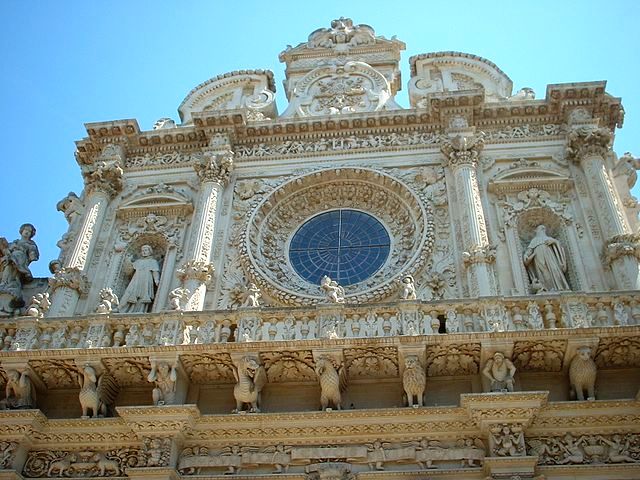
The large central rose window in Romanesque style, the rich frame, the four columns, the niches, the frames, the imaginary creatures, the animals, the mythological and historical characters of the facade are what makes this church unique and renowned world.
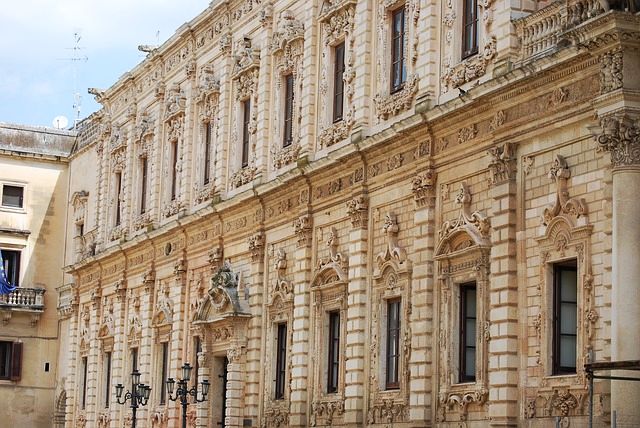
The interior is also baroque, with columns surmounted by capitals and side chapels richly decorated. Adjacent to the Basilica of Santa Croce Lecce, it does not escape the large finely decorated facade of the convent of the Celestines, which once belonged to the church, but is now home to administrative offices.
Cathedral of Lecce
A short distance to meet the Cathedral of Lecce wonderful example of baroque style, with its suggestive square, which houses the episcope and the recently renovated bell tower.
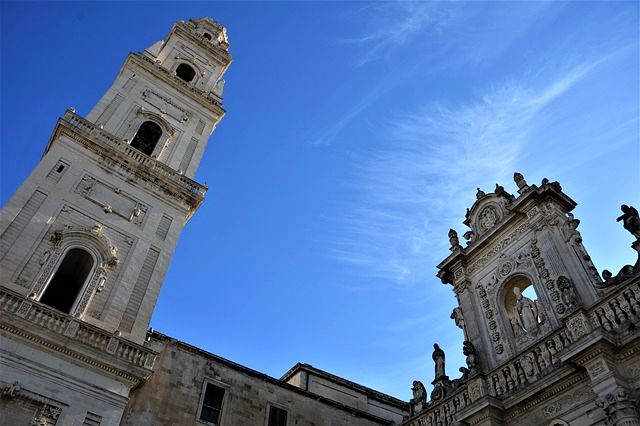
Originally built in 1144, rebuilt in 1230, then completely restored in 1659-70 by Giuseppe Zimbalo, the Cathedral of Lecce is characterized by two entrances. The main one on the north side is sober and elegant, while the portal that gives on the square is a tripudio of elaborate Baroque stone sculptures.
The main entrance is located on the north facade, considered a masterpiece of Baroque art. In the center is the portal, accessible by a staircase. The portal features two massive square columns, with niches containing statues of San Giusto (right) and San Fortunato (left).
The trabeation, placed directly above the portal, is crowned by a high balustrade alternating with columns and pillars, above which, in the center and standing inside a grandiose and very decorated arch, there is a statue of Sant’Oronzo.
The western entrance, which is directly opposite the Archbishop’s residence, is divided by pillars channeled into three vertical sections corresponding to the three aisles of the interior. Statues of Peter and Paul line the entrance.
Unlike the Basilica of Santa Croce, the interior of Cathedral of Lecce is highly decorative and has a myriad of works of art, opulent arches and a decorated ceiling.
The Cathedral of Lecce has a Latin cross-shaped plan with three aisles divided by pillars and columns, with the main altar placed at the eastern end of the church. The wooden ceiling with drawers is of 1685, as well as the paintings of Giuseppe da Brindisi showing: the Predication of Sant’Oronzo, the Protection from the plague, the Martyrdom of Sant’Oronzo and the Last Supper.
The main altar, in marble and gilded bronze, was consecrated in 1757 by Bishop Sozi Carafa, who also commissioned the large central painting, depicting the Assumption of Mary of Oronzo Tiso, and the two side images of the Sacrifice of Prophet Elijah and the Sacrifice of Noah after the Flood (1758).
On the sides of the nave there are twelve chapels, each of which is dedicated to a different saint or religious figure. The most important is the Chapel of St. Oronzo, with four statues surrounding an altarpiece depicting the patron saint of the city.
Piazza del Duomo di Lecce
After visiting the Cathedral, go out to the church and find yourself in Piazza del Duomo di Lecce, one of the most fascinating in the historic center. Surrounded by beautiful monuments and buildings including the opulent Episcope, the episcopal residence.
The bell tower was built in 1661-1662 by the architect Giuseppe Zimbalo to replace the previous Norman bell tower, erected by Goffredo d’Altavilla, which broke out at the beginning of the 17th century.
It has a square shape and consists of five rastremati levels, the last of which is surmounted by an octagonal dome in majolica, on which there is an iron statue of Sant’Oronzo. The four upper floors have a single window on each side and each has a balustrade. Incise on plaques placed above the bifores are Latin inscriptions taken from the writings of Giovanni Lecce Camillo Palma.
At a height of 72 meters, the bell tower offers a view of the Adriatic Sea, and on clear days are also visible the mountains of Albania.
Castello Carlo V Lecce
Main defensive fortification of the city, the castle Charles V of Lecce dates back to the 16th century. It has the typical trapezoidal plant with angular bastions and much of the walls and towers are still intact.
Under the reign of Charles V, the Castello di Lecce was used as a fortress for military activities, while today plays a cultural role with its large spaces used as an exhibition space. On the ground floor is the fascinating Museo della Cartapesta dedicated to art developed in Puglia in the 17th century, at the time used especially to decorate churches.


Ottimo servizio, quindi benvenuta la tua percentuale. Quanti giorni servono per fare comodamente il tour da te consigliato? Grazie
Felice che l’articolo ti sia piaciuto. Il centro storico di Lecce non è molto esteso e una giornata è sufficiente per vedere le principali attrazioni segnalate nell’articolo. Buon tour!