
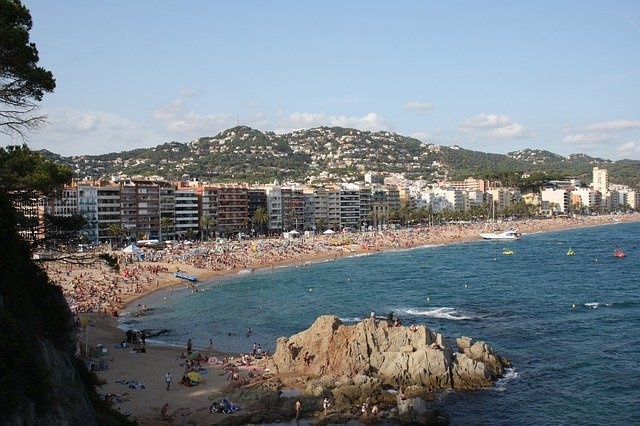
Lloret de Mar what to see and do during a holiday in the fun capital of the Costa Brava.
Located on the north-eastern coast of Spain and easily accessible from Girona and Girona airports Barcelona, Lloret de Mar is one of the most famous tourist resorts of the Spain. The beautiful sandy beach and the lively movida of clubs, bars, casinos and discotheques, make it one of the most popular summer destinations for young people in Europe and is definitely the ideal place to spend carefree sea holidays and fun.
If you want to add some interesting visits between a dive and another, you will not be disappointed. In this town of Roman origins, rich in history, there is no shortage of artistic and cultural attractions. Here are the places not to be missed in the lively Lloret de Mar.
Index of Article
Lloret Outdoor Museum
The whole old town is practically a popular museum: the Lloret Open Museum, in fact, which includes a number of different sites within and around the city, with information panels in each of them. Its unique nature also makes it an ideal starting point to start orienting and begin to know the city. Some of the highlights include the ancient Iberian foundations of the original settlement, the medieval castle of Sant Joan, which offers a suggestive view on top of the spectacular coastal cliffs and the beautiful modernist cemetery.
City hall
Designed by architects Marí Sureda and Félix de Azúa and completed in 1872, the Town Hall Palace is in neoclassical style, with its façade enriched by terracotta decorations of the vasal of Lloret, Pau Arpi Gali, including the coat of arms of Spain. The bell tower is also a remarkable feature of the building. Created by Tarrats and designed by Agusti Font Vilarrubi, it supports a watch from nearby Barcelona.
Can Comadran
Also known as Casa Font, Can Comadran is a 19th century noble house with some modernist elements. Commissioned by Nicolau Font i Maig, after making good fortune in the Americas, it was completed in 1877. Authentic Modernist architectural jewel, it is characterized by massive wooden doors, large staircases, high ceilings and modernist elements typical of the manor house. The mosaic floor adds an additional element of opulence to the building.
Chapel of Sant Pere del Bosc
One of the most interesting architectural aspects are the churches, chapels and hermits of Lloret de Mar including the Chapel Sant Pere del Bosc. Located just five kilometers from the city center, the chapel of Sant Pere del Bosc dates back to the 10th century and was used by the Benedictines until 1694, when it was burned by the French. In the following century the church was rebuilt in baroque style, but in 1860 the land and the chapel were purchased by the Earl of Jaruco, who transformed them into what is still one of the most suggestive estates of the area.
Hermitage of Our Senyora de Les Alegries
Built in 1079, the hermitage of Our Senyora de Les Alegries was the first parish church in Lloret de Mar. Located about two and a half kilometers from the city center and reachable with a short walk, until 1522 was the main church of the city. Built in a Romanesque style, it was slightly modified during renovations after the civil war. Inside you can admire frescoes of the Calandria.
Parish Church of Sant Roma
For art lovers the Catalan region has a special charm, due to the many works of art and modernist architecture scattered in large and small cities. And Lloret de Mar makes no difference with the beautiful church of Sant Roma. Originally it was built in Catalan Gothic style, while the two chapels, with their domes and turrets with coloured tiles, designed by the modernist architect Montobbio, were added later. Inside the church, visitors will find other wonderful works of art of different styles and eras.
Maritime Museum
In addition to collecting a large number of fascinating objects and findings, the Maritime Museum is set in one of the most significant historical buildings in the city: House Garriga, which in the 19th century was owned by a prosperous family of traders. The splendid exhibitions inside provide information and objects that illustrate the role that this picturesque city has played in the context of international maritime travel and commerce through the centuries.
Santa Clotilde Gardens
Considered a site of natural cultural interest, the gardens of Santa Clotilde were designed by the young Nicolau Rubio i Tuduri, in the style of Italian Renaissance gardens. Located at the top of a cliff overlooking the sea, the gardens are an emblem of the Noucentist design, which was a movement of aesthetic and intellectual renewal of the early 20th century.
The most beautiful gardens of Lloret de Mar are the ideal place for a quiet walk in nature in the shade of trees that form a wonderful contrast with flower beds, typical of Italian gardens.
The beaches of Lloret de Mar
The main beaches are wide and well-kept, while the water of Lloret de Mar is clear and crystalline, immediately deep, the coast is sandy in some sections and in other rocky.
La Platja de Lloret
The Platja de Lloret is the main beach and therefore, in full season, the most crowded. Along its golden sand strip of 1.650 meters you will find endless entertainment opportunities: in addition to taking the only you can do parasailing, swimming, snorkeling, water skiing, pedal boats, rent a canoe and much more. There are always lifeguards in service and many bars and kiosks nearby where to take a refreshing drink.
La Platja de Fenals
Practically the continuation of the central beach, but much more quiet. There are also here lifeguards, a wide range of bars and restaurants and the possibility to practice many of the same water sports of the central beach, while the rocky coves near the ends of the beach are particularly suitable for snorkeling and diving.
Platja de Santa Cristina
Step away from the centre, you will find the Platja de Santa Cristina, three and a half kilometers from the heart of the city: an idyllic place with fine sand in a bay sheltered from the surrounding woods. Boadella is the most popular nudist beach in the area, although in recent years it is increasingly frequented by families.

