
Pompeii what to see, the 3 best tours in the most famous Campania archaeological park UNESCO World Heritage.
The Archaeological park of Pompei never ceases to amaze and after decades of excavations and restorations continues to reveal new discoveries and fresh areas of restoration. The ancient Pompeii offers to the eyes of visitors other vast archaeological areas, of great importance as evidence of the past and the extraordinary richness of frescoes and mosaics, incredibly survived after almost 2000 years from79 AD. that razed it completely to the ground.
Index of Article
Pompeii
In recent years new domus has been opened to the public, such as House of Octavius Quartius where you can admire the gardens refurbished with copies of statues and furnishings. Right, the House of Venus in Shell, so called for the Parisian painting depicting the goddess on the sea. A wonderful example of a hotel with a spa: the complex of Giulia Felice. Precious and refined the decorations of the House of Frutteto, which depict fruit at the time very rare for Campania. Also open Casa di Marco Lucrezio, where Jean Cocteau photographed Pablo Picasso and Léonide Massine in 1917.
To see also the Rev. VIII: a whole neighborhood, sixty thousand square meters of domus and public buildings: are the ancestor of houses built with terraces and viewpoints on the Gulf of Naples. Beautiful mosaics in black and white tiles, pictorial cycles of mythical characters and sports activities of young Pompeians.
Reopened to the public for a few years, the Antiquarium is a place of welcome and knowledge to deepen the history of the city from its origins to 79 AD. It has been equipped with new museum and multimedia installations, spaces dedicated to exhibitions, immersive virtual reality paths to relive the tragic experience of eruption and the daily life of the time, and a new and modern bookshop.
The 3 best tours of Pompeii
The archaeological park of Pompeii is very extensive, so it is best to plan the visit well, so as to see the areas of interest. Here is a guide 3 best tours of the excavations of Pompeii.
Route 1 Entrance Piazza Esedra
This entry is recommended for those wishing to enter Pompeii directly from the Antiquarium, the archaeological museum created by Giuseppe Fiorelli between 1873 and 1874 providing a complete picture of the history of the city, with famous testimonies of Pompeiii frescoes by the House of the Bracelet Golden, the silver of Moregine, the casts of people and animals.
Today the museum has been renewed and is an introductory journey to the visit of the excavations, it seems a place of other times, where the transparent windows are like windows on the past, giving rise to an emotional journey. Along the way, we will see the Temple of Venus, where it is venerated the patron of the city, offering a magnificent view of the Gulf of Naples. What is visible today dates back to the era of the first empires.
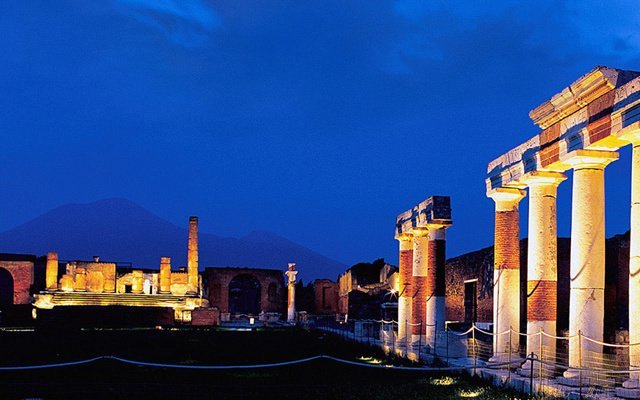
Behind the temple, let's see Hole where are located Temple of Apollo and the Temple of Jupiter. The Forum is considered the heart of ancient Pompeii, this imposing square, with public and private buildings, is the place where everything happened: it was not only a place of worship and religion, but also of justice and politics. The Temple of Jupiter is located on a high platform on the north side of the Forum, with breathtaking views of the Vesuvius. The temple is a real Capitol with three statues of Jupiter, Juno and Minerva shaped on the Roman Capitol.
Dating back to Roman times, the Temple of Apollo is one of the oldest temples in the city and the most frequented, and at present the bronze statue of the god represented by the archer, before which you can admire the statue of the goddess Diana.
Route 2 Entrance Piazza Anfiteatro
This route is part of the itinerary "Pumps for everyone" for people with motor disabilities. From the square we are right in front of theAmphitheatre, probably the oldest building in the world, the scene of bloody battles between gladiators and with a capacity of about 20,000 spectators.
It was located in the outside areas of the city to promote the influx of people. It is a magical place, not by chance chosen in 1971 by Pink Floyd to record a public-free music video that marked one of the most beautiful pages of rock music.
Next to the Amphitheatre is the Palestra Grande, the largest gymnastic structure of the city, where young people gathered in the "iuvenum allergy" wanted by Emperor Augustus to impart physical and intellectual formation.
Along the way, you can admire the Casa di Marco Lucrezio, where Jean Cocteau photographed Pablo Picasso and Léonide Massine in 1917, la House of the Frutteto, which depicts fruits at the time very rare for Campania, and the Regio VIII, an entire district of domus and public buildings.
Along the main road we find the Garden of Fugitives, a place of great charm, among the most suggestive of Pompeii: in this corner you can see the casts of 13 victims of the terrible eruption of 79 AD. A gallery that bears witness to the drama of time and the real expressions of the faces, positions and folds of the clothes in the moments before being trapped in the fury of Vesuvius.
Passing through the gardens or the amphitheatre of the Great Gym, you can visit the house of Octavio Quartio, at whose center stands the canal with its pool, once animated by water games.
From here you can reach the Domus of the European Ship, which opened the visit to the lush vineyards, once used by the owners of the house for the production and trade of wine. Thanks to a recent historical reconstruction project, the interior garden has also been restored to its splendor with the planting of the maritata screw, technique that provides the planting of the vine on a supporting tree, used since ancient times until the whole 800 in the Vesuvius region .
Route 3 Entrance Porta Marina
Porta Marina is called so because overlooking the sea. Under its walls, directly accessible from Via Marina, there are the Suburban baths, known for the erotic frescos of the Apodyterium (spogliatoio). Their location is no coincidence, in fact they were built outside the walls not only to attract people from the city, but also visitors passing through.
It is a public spa complex of the Augustean era, with male and female changing rooms, erotic themed frescoes that promote events that took place in the rooms on the upper floor. Other thermal baths, however, are decorated with mosaics and paintings depicting amorini, naval battles and marine animals.
In the life of the Pompeians the thermal baths were sacred, an indispensable daily ritual, a place of relaxation, but also of discussions of politics or private life.
Up to the Forum you can move towards the Casa del Fauno, the largest and most spectacular among the patrician domus. Built in the 3rd century BC, the house house housed the famous statue of the dancing Fauno, today exposed to the Archaeological Museum of Naples. The house consists of two courtyards with porticos, bathrooms, dining rooms and representative halls, all enriched by fine mosaics and frescoes.
In via del Vesuvio you can then visit the Domus of the Golden Amorini or admire the fresco of Leda and the Swan in the homonymous house.
Continuing our journey, we meet the Basilica, a space for business management and judicial administration. Conceived as a sort of Forum, but in the closed, there were the same functions in case of bad weather. On the one hand there was the court with the outburst of the judge elevated to the parts and only accessible from a wooden mobile scale, to prevent the magistrate from being attacked by the condemned.
Along this path, you can also admire the famous House of the Vettii, with its magnificent frescoes and mosaics, and the Piccolo Theatre, where theatrical and musical performances took place. The route ends at House of Menandro, where is the famous mosaic depicting the great Greek commediograph.
In summary, these are the 3 best tours of Pompeii. I recommend you plan your visit carefully, so you can admire all the wonders this archaeological site has to offer. Pompeii is an enchanted place that will leave you speechless, an exciting journey in the past that you will never forget.

