

From what to see in the fairytale city in Portugal, a perfect combination of stunning palaces, castles and nature, so much to have been declared a World Heritage Site by UNESCO.
Surrounded by forests, this resort is 25 kilometers from Lisbon It is famous for its fabulous castles, breathtaking and extravagant palaces, so much so that you have the feeling of being in an enchanted place, where elegance and opulence blend, history and modernity.
There is no wonder, therefore, if for its solemnity Sintra has been defined by many poets "the most beautiful place in Portugal". Let's find out what they are and what to see in Sintra.
Index of Article
What to see
Palácio Nacional de Sintra
It is a royal palace, which became the symbol of the city.
The first news of the existence of the castle, reported by Arab Al Bakri, date back to the XI century, later it is reported that King John I gave it to the de Seia, then returned to the royal house .
It is a true museum of azulejos, magnificent ceramic tiles not very thick, with the decorated surface spread throughout Portugal.
It is assumed that in the chapel inside the building there is the oldest azulejo in Portugal, built during its reconstruction in 1489, when the works were started to lighten the mass of the building and realize the decoration of its interior.
The interior furnishings of the building have an invaluable value, reflecting different architectural styles such as Gothic, Medieval, Renaissance and the taste of the kings who lived there.
Although it is a service environment, the kitchens are the most special part of the building thanks to the large conical fireplaces, 33 meters high, which have become a symbol of the city.
In the last years of the monarchy, she had the function of summer palace of Queen Maria Pia, the last royal to live in Sintra.
The Palàcio Nacional De Sintra is apparently a set of separate buildings that, however, are part of a single complex, connected by stairs, courtyards and galleries: it is the best preserved royal residence of Portugal, declared World Heritage by UNESCO.
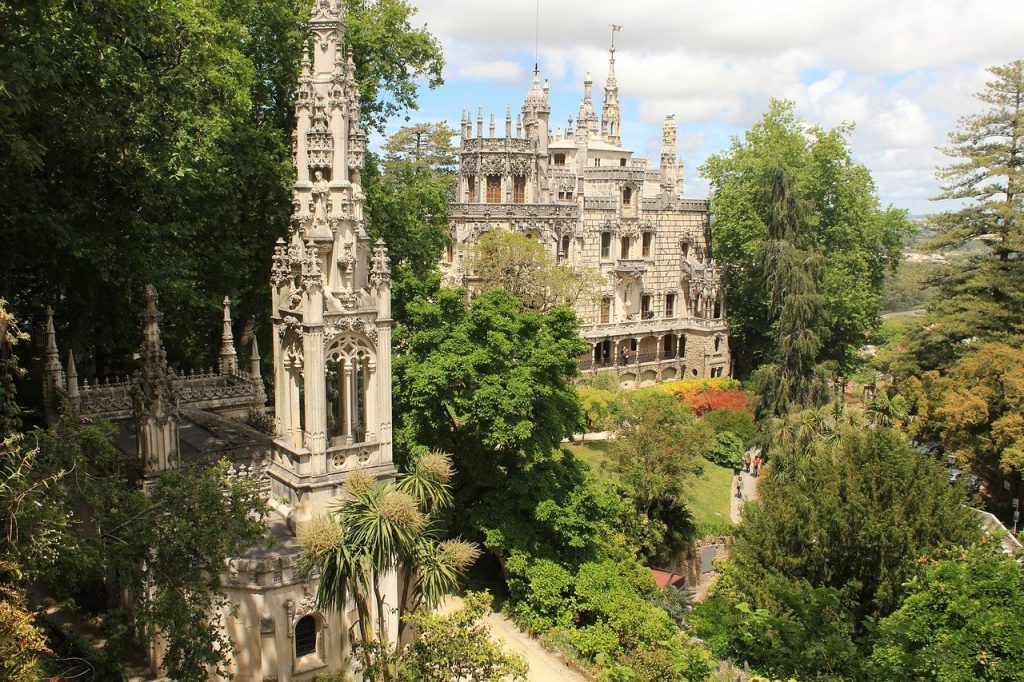
Palácio de Regaleira
One of the most enigmatic places in Sintra is a strange domain that extends over four hectares and contains labyrinths, statues, caves and ponds.
Unlike what one might think, it is not a very ancient building, it was built between 1901 and 1910 at the request of Augusto Carvalho Monteiro, based on a project by Italian Luigi Manini.
Really particular are the spiral wells that emerge from the basement. Because of their structure, it was believed that they were built to collect rainwater, instead it seems that here there were secret initiation rites, probably Masonic.
The Initiatic well consists of a new staircase from which it descends to a depth of 30 meters, the number 9 would call the ring of Dante's Divine Comedy, and below you can see the Templar Cross, a symbol linked to the legendary secret order of the Rosacroce.
The unfinished well, as the name suggests, has never been completed.
It consists of a staircase of steep steps, many of which recall Masonic principles, which acts as a link between the two wells.
Today the building belongs to the municipality of Sintra and is home to the Foundation Cultursintra, is part of the historical center of Sintra World Heritage UNESCO. It is definitely a magical place that deserves to be seen.
Palàcio da Pena
Perched on a hill, it rises in the place where once a convent was.
During an excursion, King Ferdinand of Savoy, husband of Queen Mary II of Portugal, discovered the monastery, inside which only a chapel with 15 niches representing scenes of the life of Christ remained intact.
The king fell in love with the site and the queen bought it as a wedding gift for the wife, lover of art. Ferdinand II entrusted the restoration to Ludwig Von Eschwege, who had the mission to erect a palace that had the appearance of a opera.
The eccentric palace is a colorful fairytale castle, surrounded by 200 hectares of forests. The interior is a harmonious blend of architectural styles, baroque, Renaissance, Arabic style; while the interior is still furnished according to the taste of the kings who lived there.
From the spires and terraces you can admire the breathtaking panorama that extends to the ocean. During the 1910 revolution the palace fell into ruins, but it was later restored and today it is a UNESCO World Heritage Site and is considered one of the wonders of Portugal.

