
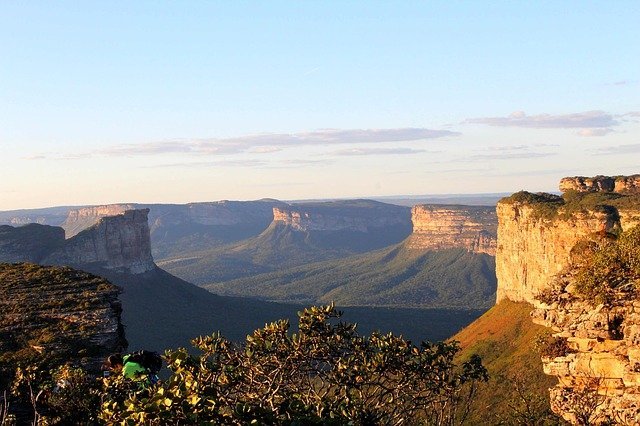
Not only Amazon Forest: Brazil is an ecological paradise with dozens of natural parks to discover. The Northeast Region is the one that offers the best possibilities for trekking lovers.
In this area there are seven National Parks, which have facilities for visiting and practicing sports activities.
Index of Article
Chapada Diamantina National Park – Bahia
In the state of Bahia, the protagonist is the National Park of Chapada Diamantina, an area with incredible landscape, rich in mountains, plateaus, rivers, rapids, waterfalls, caves and springs of transparent water, which extends for 152,000 hectares in a region whose beauty does not know equal.
Paths with different degrees of difficulty, many of which date back to the time of slaves and gold seekers, cross the park.
There is no signage for such routes, it is absolutely essential to be accompanied by a local guide, especially in the longer routes. During walks you can admire beautiful orchids, cactus and all the wonderful flora typical of the area.
Chapada dos Guimarães National Park – Mato Grosso
In the heart of Brazil, the Central-West Region, there are four National Parks, of which the most famous is the Chapada dos Guimarães in the State of Mato Grosso. Created in 1989, the park has huge and characteristic formations of sandstone rock, offering a suggestive view of the alluvial plain.
The rich hydrography of the area and the sudden changes of altitude give rise to numerous waterfalls throughout the area. Among these, the cascade known as "Il Velo della Sposa", near the Visitor Centre, became the symbol of the Chapada dos Guimarães.
Walking through the forest, you come across an untouched nature, where the twisted trees intertwine in unique designs. You will immerse yourself step by step in the dense vegetation and you can admire the exotic fruits typical of Cerrado (the name with which this eco region is defined).
The park can be visited throughout the year, but the best period is between May and June, when the region is in bloom and the waterfalls are full of water. In the rainy period – between December and April – the paths become rather dangerous and access to some areas of the park is closed.
Aparados National Park from Serra – Rio Grande
We continue our journey between the National Parks of Brazil with a bet in the South of the Country, where the major attractions are the National Park of Aparados da Serra and the National Park of Serra Geral.
In the Park of Aparados da Serra, in the state of the Rio Grande del Sud, there is the famous canyon of Itaimbezinho – Itaimbé, in the native language of the indio, the Tupi-guarani, means "stone cut" – 720 meters deep and 6 kilometers long.
Well-marked trails lead visitors to the discovery of incredible landscapes designed by rocks and waterfalls. The park also has a Visitor Centre for the reception of tourists.
Serra Geral National Park – Rio Grande
In the near Serra Geral National Park, one of the unmissable attractions is the canyon of Fortaleza, about 8 kilometers long and 900 meters deep and 1,500 wide. To cross it you can choose from various types of routes, some of which pass right through rock formations.
This park is rich in waterfalls and offers the possibility of long walks, even if the most challenging are to be undertaken with the help of an expert guide, easily available in the nearby National Park of Aparados da Serra.
Foz do Iguaçu National Park – Paraná
Always in the south, Foz do Iguaçu, west of Paraná, is the most visited national park in Brazil. Every month thousands of tourists walk through the forest in front of the waterfalls of the river Iguaçu, a real natural monument.
The visual and sound impact of the water’s strength from a height ranging from 40 to 85 meters high literally awakens the senses.
According to geologists and historians, waterfalls at the mouth of the river formed a million, perhaps a million and a half years ago. The blocks from which the waters fall are of basaltic volcanic origin dating back to the Cretaceous period and beautiful canyons have been excavated by natural erosion.

