
What to see in Wyoming? A complete guide to places not to be missed during a trip on the road in the legendary West, the heart of America most authentic. The real travelers know it well: the United States must be explored at the wheel of a car with radio tuned on a country music station, soundtrack ideal to walk in freedom panoramic roads that go through forests, national parks and futuristic metropolis.
Index of Article
Wyoming itinerary in the West on the road
Denver, Colorful
The journey can only start from Denver, Colorado, also because here is the nearest international airport. The Queen City of the Plains is a dynamic, vibrant city full of energy and creativity, able to offer culture and surrounded by an incredible natural beauty.
It is very easy to travel to Denver and the inhabitants of the city will make you feel at home. The Denver gastronomy, nightlife, art and cultural scene are very exciting. Discover Larimer Square, an ancient area with very well-preserved buildings, which today house restaurants, bars and craft shops.
Walking up to Confluence Park, admire the beautiful view of the mountains and watch the cyclists pass, or rent yourself a bike and join them! Or board the 16th Street Bus, a free shuttle that will take you to the State Capital, the Denver Art Museum and the Colorado History Museum.
Make a stop at the historic Brown Palace for tea, then continue to Larimer Square to drink a cocktail and admire the sunset over the mountains from the panoramic terrace of the Tomayo’s restaurant. You can then continue the evening in the LoDo district, very fashionable, which is full of locals, restaurants and ...pianos scattered along the way, where everyone can sit and play something!
Cheyenne capital of Wyoming
Next stage Cheyenne capital of Wyoming, which owes its name to the Cheyenne, one of the most influential native tribes in the area.
Often referred to as "The Magic City of Plains", its foundation dates back to the eighteenth century, when General Grenville M. Dodge and his colleagues designed an outpost known as Cheyenne in the Dakota territory, where the Union Pacific Railroad intersection met Crow Creek, initially called "Crow Creek Crossing".
Visit the State Capitol Building and the Historic Governors’ Mansion before taking the Happy Jack Road west towards Curt Gowdy State Park, considered the realm of mountain biking. Infinite km of trails cross the park and allow hiking and even more amateur walks.
Laraemia
At sunset, head west on the I-80 for Laramie, to enjoy a dinner in pure western style and for an overnight stay in a typical hotel in the area.
The next day, depending on your preferences, you can visit a museum; in this college city, there is only the embarrassment of the choice between the Tate Geological Museum, the American Heritage Center, the Wyoming Territorial Park, the Laramie Plains Museum and the University of Wyoming Art Museum.
If you are in the area at the beginning of September, make room in your itinerary to assist in Snowy Range Music Festival. You'll be full of energy with the blues music of the best American interpreters before continuing your journey to the next stage.
From Laramie, take the Snowy Range Scenic Byway, one of the most spectacular West Roads. A word is enough to describe the views from the top of the pass: breathtaking. The panoramic road crosses the Medicine Bow Mountain Range and includes over 45 km of the portion of the Medicine Bow-Routt National Forest on Highway 130 in Wyoming, where you can admire local fauna, snowy peaks (also in July and August) and an intact landscape.
Without stopping the trip takes about an hour, but take some time to enjoy the beautiful view.
Saratoga spa city
The road will take you directly to Saratoga, where hiking and biking trails abound, giving you the opportunity to stretch your legs after travelling by car.
Mirror Lake is a secluded place to picnic in nature. This land has a long history, dating back to about 8,000 years ago when the ancestors of the Indians of the prairie lived here. Northern Arapaho, Oglala Sioux, Northern Cheyenne, Eastern Shoshone and White River Utes attended all this region.
The wood used to make their bows came from the forest. The hot water hot springs along the banks of the North Platte River provided a place to "practice medicine", to cure diseases and to keep their sacred gatherings – the powwows.
The area around Saratoga is renowned for its natural sources of hot water. Immerse yourself in the mineral healing waters at the Hobo Hot Pool near the city centre, or stay at the luxury Saratoga Resort and Spa. The public entrance to the thermal springs is free and the town is only a short drive from Byway.
Seminole State Park
Then head north to Seminole State Park for a day in one of the largest and most famous reserves of the state, ideal for water activities.
The morning is the ideal time for Fishing in the North Platte River, a portion of the river so famous for the abundant blue-ribbon trout fishing that has been nicknamed "Miracle Mile" Numerous local outfitters can provide you with all the equipment and all the information for the best places to fish.
Three boats provide easy access to the water, allowing you to spend a pleasant afternoon surfing the crystal clear waters of the lake. Other activities in the park include: hiking, biking, camping and picnic facilities.
Wind River Reserve
The Wind River Reserve is the only one in Wyoming that hosts native American tribes from Northern Arapaho and Eastern Shoshone. The territory of the reserve extends for over 88,000 hectares between the scenic Wind River Range and Owl Creek Mountains, and includes the towns of Riverton, which has airport, Lander south and Thermopolis northeast.
The Wind River flows through a landscape among the most suggestive of the state of Wyoming, offering water for irrigation, as well as for recreational activities.
The reserve seat is located Fort Washakie, a former military base in the United States, often visited by the native Shoshones. The only American fort named after an Indian leader also houses the interesting Shoshone Tribal Cultural Center that offers a thorough approach to the culture of the tribe, with exhibitions of tribal artifacts, arts and crafts, as well as a collection of photographs and information about Cape Washakie and Sacajawea.
Few know that native Lehmi-Shoshone Sacajawea, who accompanied explorers Lewis and Clark in search of the northwest passage, is buried in the Wind River reserve, right near Fort Washakie. Its tomb is located at the foot of the gentle hills of the Wind River and the imposing Sacajawea mountain, 4000 meters high.
Grand Teton National Park
The more than 125,000 hectares of the Grand Teton National Park include lush valleys, mountain meadows, alpine lakes and peaks of the Teton Range.
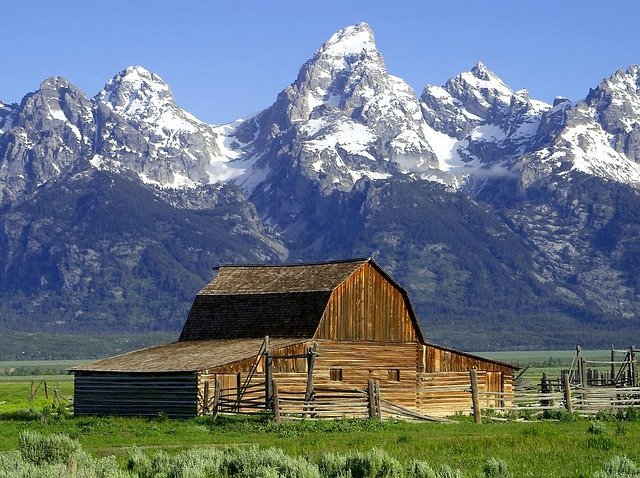
If iconic landscapes like Mormon Row and Moulton Barns are among the most photographed locations in the park, the majestic peaks of the park Grand Teton National Park are the perfect setting for nature lovers, outdoor enthusiasts and all travelers who want to explore the incredible landscapes of the park.
Bisonti, deer, elk, bears and bighorn sheep and other wild animals can easily be seen during excursions through forests and grasslands or by taking the panoramic US Highway 89 comfortably by car.
Jackson Hole
Located south-east of the Grand Teton, or "The Grand" as the locals call it, Jackson Hole is a typical town where you can breathe the authentic western atmosphere, the main gateway to the national parks Grand Teton and Yellowstone.
Become a popular tourist destination in recent decades, it preserves many buildings and attractions of the past, such as the popular Million Dollar Cowboy Bar or the horn arch of walnut that decorates the main square.
The old Wort Hotel has also managed to maintain a bit of the original western taste with an exhibition of black and white images of famous actors and actresses of cowboy movies of the 1920s, ’30 and ’40 that frequented the area.
Not to be confused with cowboys – these are authentic and in flesh and bones – which are still turning around the most western city of Wyoming.

