
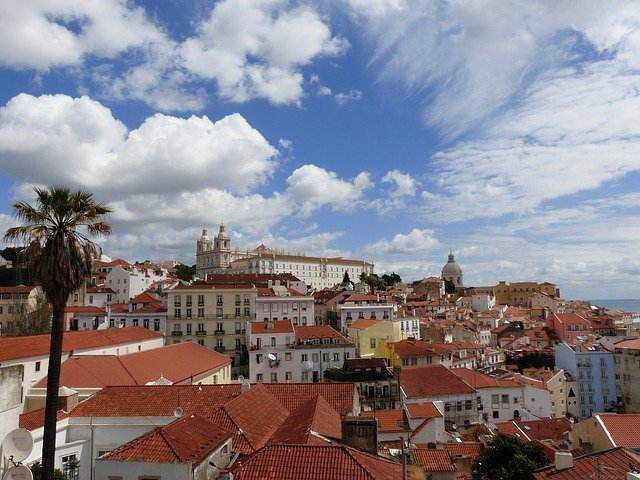
City of seafarers and fishermen a stone’s throw from the Atlantic, Lisbon has always had a privileged relationship with the sea. Then let the water guide us in a fascinating itinerary "liquid" to discover the Portuguese capital and its surroundings.
From the Tejo River, the largest of the Iberian peninsula, which after a few kilometers flows imposing in the Ocean. The wide water course is an integral part of life Lisbon: you can make pleasant cruises and long walks, stopping in more open spaces with tables and river views.
From here we head towards magnificent Oceanario built in 1998, the year in which Lisbon hosted the Expo, it was voted by Tripadvisor users the best in Europe, so it absolutely deserves a visit. It is located in the National Park district and is the largest in the continent, containing 15,000 specimens of animals and plants of many marine species, not only fish but also birds and mammals.
It is organized in tanks divided by oceans: in the center there is a huge basin containing species that live in full ocean like sharks; around there are four smaller tanks that instead show fauna and flora of the Atlantic, Pacific, Indian and Antarctic regions.
Our itinerary continues outside the city. A few kilometers from Lisbon there is a beautiful coast overlooking the Atlantic Ocean, dotted by suggestive places. Near the Tagus estuary is located the beautiful town of Cascais, reachable from the capital with a comfortable train, one of the first electric lines of Europe.
Once a fishing village and summer residence for the royals, today Cascais is a lovely place, where you can admire beautiful villas on the coast, the Do Mar Museum and a long promenade along the sea to Boca do Inferno: a cave where the ocean breaks with very high and noisy waves.
Following the wild coast towards the north, you arrive at Guincho beach, very famous and frequented by surfers. Guincho is very wide and deep, made of picturesque golden sand dunes that constantly change design with the wind: the true protagonist of this beach and the entire coast. Similarly the wind also plays with the sea, always ensuring incredible choreographic waves.
A dozen kilometers further north is Cabo da Roca, the westernmost point of Europe, which Camões described: "the place where the land ends and the sea begins". Cape da Roca is a cliff overlooking the Ocean, a 140 m high promontory beaten by the wind and punctuated by a lighthouse from which it is nice to greet the sun that sets.
To sleep, you can book in one of the five Heritage hotels, choosing from contemporary design facilities or extremely romantic boutique hotels located in the most charming neighbourhoods of the city.

