
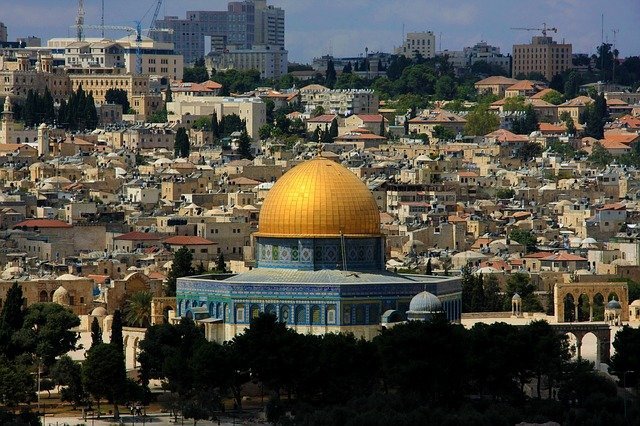
Living the rites of Easter in Israel, retracing the places where the Passion of Christ, it is an experience to do at least once in life, regardless of your religious belief. Also because this is the only place in the world where sacred rites Christians, Hebrews and Orthodox are intertwined and sometimes (depending on the calendar!) ceremonies end with happening in the same days and places, amplifying the festive climate with pilgrims from all over the world.
This year, for example, Christian Easter falls on 5 April, overlapping at the beginning of the celebrations festival of Pesach, the Jewish Easter, which commemorates the Exodus from Egypt of the Jewish people led by Moses.
Also called Freedom Day, as it symbolizes liberation from slavery, emphasised in rituals and prayers, Pesach is a celebration to live in the family, during which the precept of eating is observed Matzah, i.e. unleavened bread, as he was forced to make people Israel fleeing precipiously from Egypt.
More or less in the same days, instead, for Christians the Old Town of Jerusalem and the surrounding hills return to be the scenario in which the re-enactment of Holy Week, from the Procession of Palms to the Resurrection of Christ.
A tradition born here, at the dawn of Christianity, and then spread in the West, but that every year continues to attract Easter in Israel thousands of pilgrims from all over the world. If you have a plan trip to the Holy Land at Easter, you might then be useful to know how and where the rites of Holy Week to better organize your itinerary.
The sacred rites of Easter in Israel
The celebrations begin Palm Sunday, with the solemn morning ceremony of blessing of the Palms in the basilica of the Holy Sepulchre, then followed by the festive procession of faithful who descends from the sanctuary of Betfage the Mount of Olives, singing hymns and waving palm branches in memory of the triumphal entrance of Jesus to Jerusalem.
A joyful moment and great devotion, which according to the tradition of the Gospel precedes the arrest of Christ. To the procession, led by the Patriarch of Jerusalem together with the Custos of the Holy Land, the various religious communities present in Holy Land, including Coptic Christians of Egypt and Protestants of the various Churches present at Jerusalem.
The Passion rituals they take the Holy Thursday with the commemoration of the Last Supper and the lavender ceremony celebrated by the Latin Patriarch to Holy Sepulchre, in memory of the previous hours the arrest of Jesus in Gethsemane, the place of the betrayal of Judah. Here is the basilica of Agonia that guards the naked stone on which the night of Passion of Jesus, where in the evening the faithful gather for the meditation of the Holy Hour.
The Friday, along the Dolorosa street inside the old town, the solemn Via Crucis led by the Latin Patriarch and the Custos of Holy Land, that traces the places of the passion of Christ, from the condemnation to death on the Golgotha, according to a devotion that goes back to St. Francis and his journey to the Middle East, after which the Saint of Assisi founded the Order of the Friars Minor, which has the mission of Custody of the Holy Land.
The Via Crucis from the courtyard of the Muslim school el-Omariyya, in front of the Franciscan monastery, where the I station is located, and after crossing the heart of the old town, it reaches the Basilica of the Holy Sepulchre, within which the last five stations are offered.
The X and the XI station, that is, the stops of undressing and crucifixion, are performed in the chapel of the Crucifixion, property of the Latins, while the XII station, which recalls death on the cross, is located in the Chapel of Calvary, which belongs instead to the Orthodox Greeks.
The property of Holy Sepulchre In fact, it is divided between six Christian denominations: in addition to Latins and Greeks, there are also Armenians, Copts, Syrians and Ethiopians. A division according to the Status Quo established in the 19th century, that is, the set of historical traditions, laws and regulations, which establish relations and activities within the Basilicas that are owned by several Christian denominations.
After the Via Crucis the funeral of Christ, which evokes the deposition of the body of Jesus in the tomb: it is a unique event of the church of Jerusalem, which is followed, on Saturday, the great Easter vigil. On Sundays, finally, the feast of the Resurrection explodes, and it is necessary to arrive early in the morning in the Basilica of the Holy Sepulcher to attend the solemn Mass of Easter celebrated by the Latin Patriarch and the solemn procession around the tomb of Jesus.
#GoIsrael #TBnet #

